Showing posts sorted by date for query brain mets radiation and anti-PD-1. Sort by relevance Show all posts

Thursday, April 28, 2022

Primer for Current Melanoma Treatments - New and Improved Version 2022!!!!

Originally posted in 2017, sadly, this primer has needed little in the way of updates since.  Still, there have been a few FDA approvals, meds I didn't include in the first rendition, and some news in the research so it is getting a reboot. Initially created to save re-writes for those in need, I still answer melanoma questions on boards or via email at least every other week, but want to emphasize that this is not an all inclusive listing.  Rather, this is a basic guide to use in starting your research or discussions with your provider regarding melanoma care.  As recently, as 2010, NONE of the current, most effective treatments for melanoma were FDA approved.  Since then, doctors have become more knowledgeable about consistently offering and better skilled in managing these treatments.  Still, it is essential that you be seen by an oncologist who specializes in, or at the very least, has treated many patients with melanoma.  Sometimes a picture is worth a thousand words ~ 

Here we go:

SURGERY

Surgery remains a good choice for many melanoma patients.  Clearly this is the case for a new cutaneous lesion.  Surgery results in an immediate decrease in your tumor burden - almost always a good thing.  However, with data showing good results in NEO-adjuvant treatment, the possibility of using intralesional therapy, or if you are looking for a clinical trial, there are times when measurable disease is needed, so a discussion of these things before surgery is important.  However, for patients with advanced disease decreasing tumor burden through surgery remains an important option for increased survival.  This 2019 report addresses some of the conundrum:  Cut it out!!! Prolonged overall survival following metastasectomy in Stage IV melanoma 

RADIATION

Radiation, when combined with immunotherapy or targeted therapy, can be a very good treatment option for melanoma.  Together, radiation and systemic therapy can illicit responses that are greater than either treatment used as a single agent.  However, targeted radiation (SRS - stereotactic radiation or Gamma Knife) is the most effective whether you are talking about brain tumors or lesions in the body.  We have learned that whole brain radiation (WBR) is not the most effective way to treat melanoma and can lead to debilitation.  While there are those who must avail themselves of this treatment due to extreme circumstances, it should not be the first recommendation right out of the box for those with brain tumors.  Even multiple brain mets can be treated simultaneously with SRS.   Here are zillions of reports regarding the effectiveness of using radiation WITH immunotherapy: Radiation WITH immunotherapy  Here is a report from 2019 regarding the use of radiation prior to targeted therapy:  Better melanoma results with radiation BEFORE BRAFi (at least in this report)

IMMUNOTHERAPY

These are treatments that push our immune systems into action.  Side effects (as you might imagine) are usually related to an 'over activation' of the immune system.  Common side effects include - fatigue, rashes, joint pain.  More complicated side effects are inflammation of the lungs (pneumonitis) and colon (colitis) with difficulty breathing and wheeze or diarrhea and abdominal discomfort, respectively.  Patients can experience problems with thyroid function and other glands of the endocrine system.  Responses take time.  Experts are known to advise other docs to be 'patient with the patient!'  Immunotherapy works best with the lowest tumor burden.

Old school immunotherapy

Interferon

Discovered in 1957, interferons are a type of signaling proteins released by cells in response to viruses, bacteria, parasites, and tumors that help rally the immune response of the body against these invaders. In the early 1980's researchers and pharma were finally able to produce interferon for use as a medical therapy. There are many forms, used in treating various conditions (some more effectively than others) from multiple sclerosis to leukemia to melanoma. Often given as subcutaneous injections (though there are eye drops and inhalation forms), interferon causes significant side effects with fatigue, flu-like symptoms, hair loss, pain, depression and increased risk of infection due to neutropenia (decreased white cells) being common. Unfortunately, we have learned that in melanoma, interferon has a clinically insignificant effect on progression free survival as well as overall survival.

IL-2 (Interleukin 2) also known as aldesleukin, proleukin, and/or sylatron

Similarly, IL-2 is a signaling molecule that directs the actions of white blood cells in getting rid of invaders. Isolated in 1979, by the early 80's pharma (Ceta, Amgen, Roche) were in a mad dash to get a drug to market. It was FDA approved in 1992. It has been used in the treatment of HIV, renal cell carcinoma, and melanoma. Though it can be injected subcutaneously on an outpatient basis, in melanoma it is most often given in an IV infusion, with side effects (extreme swelling, rash/peeling skin, hallucinations, among other horrors) such that patients must be in the hospital, in an intensive care setting, for infusions that are given every 8 hours for up to 15 doses or as the patient can tolerate. It is also used in a low dose regimen with old school TIL therapy as a way to jump start the immune system after chemo has been given to eradicate existing regulatory T cells and new T cells grown from the patient's tumor have been infused.  See this 2021 report:  TIL - A report out of ASCO 2021 and incredible words from one of Melanoma's Most Fearless and Inspiring Leaders  It is also being studied as an intralesional (see below). Ultimately, we now know that the use of high dose IL-2 in melanoma can produce a complete response in about 5-6% of the patients, with some of those responses being durable (lasting).  

Current Immunotherapy (also referred to as Check Point Inhibitors)

Ipilimumab (Brand name = Yervoy, slang = 'ipi') – anti-CTLA-4 monoclonal anti-body

Ipilimumab is a monoclonal anti-body that is used to restart the immune system by targeting CTLA-4, a protein receptor that actually turns the immune response OFF!!! The concept of using anti-CTLA-4 antibodies to treat cancer was developed by Dr. James Allison, for which he was awarded a Nobel Prize in 2014.  It was approved for melanoma (Stage IV or unresectable Stage III) in 2011. It was approved as an adjuvant treatment for melanoma in 2015. However, we have since learned that melanoma patients with advanced disease respond much better to the ipi/nivo combo rather than ipi as a single agent and folks in need of adjuvant therapy do much better with one of the anti-PD-1 products.  Ipi as a single agent was administered via an IV infusion every 3 weeks, for a total of 4 doses, at 3mg/kg for Stage IV patients and 10mg/kg for adjuvant therapy. Some adjuvant treatment plans continued ipi at that same dosage but every 12 weeks for up to 3 years. Melanoma patients given ipi can attain a response rate of about 15%. Responses can be durable.   Patients experience more side effects with ipi than they do with anti-PD-1 products and ipi is the bad boy of side effects in the ipi/nivo combo.  Ipi at 10mg/kg produces more side effects than ipi at 3mg/kg.  The ipi/nivolumab combo was FDA approved in (2015).  In that treatment, patients are given an infusion of ipi at 3 mg/kg after nivo at 1mg/kg is given on the same day, every 3 weeks, for 4 doses, followed by one year of nivo as a single agent. 

Anti-PD-1 (Brand names = Opdivo and Keytruda, Nivolumab and Pembrolizumab respectively.)
      
Background:  PD-1, also called programmed cell death protein 1, is a membrane protein and a T cell regulator, first discovered to be an immune checkpoint in 2000.  PD-1 is expressed on the surface of activated T cells, B cells and macrophages (white cells that can be involved in tissue repair or digestion of debris or pathogens). Compared to CTLA-4, PD-1 is keyed to specific tissues with the PD-L1 ligand, while CTLA-4 is less specific.

PD-L-1 is a ligand present on the surface of melanoma tumors (as well as some others) that can bind to infiltrating t-cells and turn them off!!
  
ANTI-PD-1 (the drugs) are monoclonal antibodies that block the switch on T cells so that PD-L1, on the surface of melanoma tumor cells, does NOT bind with them and turn them off....thereby allowing these cells to carry on and destroy melanoma tumors.

Sometimes pictures tell the story better:
    Nivolumab: (Brand name = Opdivo, slang = 'nivo') - anti-PD-1 monoclonal antibody
I wrote a little story about the development of nivo here, but basically, in 2014 Nivo was approved for the use in advanced melanoma patients only AFTER they had failed ipi and, if BRAF positive, BRAF inhibitors as well.  In November 2015 it was approved as a first line drug for unresectable or advanced melanoma BUT you had to be BRAF positive.  (A cosmically ridiculous judgement since we already had studies proving that BRAF status made little to no difference in response!!)  Finally, in 2016, based on the results of the  Checkpoint-067 study, nivo was approved for use alone or in combination with ipi, in advanced melanoma patients, no matter BRAF status.  And in 2017, it gained approval as an adjuvant treatment option.  This was seriously good news!!!  It meant even if you are Stage IV with all tumors removed (or zapped) - you can still take nivo.  Or, if you are Stage III with melanoma that went to your lymph nodes - you can take nivo!   Since then, nivo has also been approved for use in NSC lung cancer, urothelial and renal cell cancers, gastric and esophageal cancers, hepatocellular carcinoma as well as head and neck cancers.

      Pembrolizumab: (Brand name = Keytruda, slang = 'pembro') - anti-PD-1 monoclonal antibody
Pembro was similarly approved for advanced melanoma in 2014.  Since then it has been approved in various algorithms for NSCLC, head and neck squamous cell cancers, Hodgkins lymphoma, and endometrial cancers.  In 2019, it was approved for adjuvant treatment of Stage III melanoma and for Stage II adjuvant melanoma in December of 2021.

Response rate and side effects for advanced melanoma patients:

Both anti-PD-1 drugs as single agents effect about a 40% response rate in melanoma. They can work in the brain and the body.  Median time to response is about 3 months.  But, there are outliers, with documented responses, that do not occur until 6 - 9 months.  Here's a cool graph...
Here's a post with more info: Time to Response...Ipi vs Nivo and ipi 
Responses to immunotherapy have proven to be durable!!!   This post includes neat charts regarding response and durability to Pembro: Dr. Daud review from ASCO 2016   There is this from 2020:  Response after discontinuation of anti-PD-1 in melanoma patients whether due to disease progression, side effects or choice  And this from 2021:  ASCO 2021 - Outcomes of treatments on advanced disease - Reasons for HOPE!!!!!

Side effects are similar for both drugs and are those typical for immunotherapy, but less severe than those encountered with ipi.  As expected, the ipi/nivo combo has greater side effects than when nivo or pembro are used alone.  On the topic of side effects...they SHOULD be treated!!!  As quickly as possible.  At times, a break from medication and immunosuppressive drugs are required.  While oncologists not familiar with immunotherapy may fear decreased therapeutic response if steroids are used...the preponderance of the data indicates that THIS IS NOT THE CASE!!!!  Clearly, one should not take immunosuppresive drugs unless absolutely needed.  Many patients require varying doses of steroids in order to tolerate necessary, life saving melanoma treatments  and go on to do well!  Further, folks with pre-existing autoimmune disease can be managed on immunotherapy and gain a response as well.  Here are a zillion reports on all of that jazz:  What to do about immunotherapy if you need steroids or have a pre-existing autoimmune disease?

Dosing:

When Pembro is used as a single agent = is dosed at 2mg/kg with max of 200 mg IV every 3 weeks - for one year as adjuvant, end point undefined for advanced melanoma patient.  Nivo as single agent = is dosed at 240 mg IV every two weeks or 480mg IV every 4 weeks - for one year as adjuvant, endpoints vary for advanced melanoma patients. When ipi is combined with nivo, response rates in melanoma rise to 50+%, though side effects increase as well - mostly due to ipi.  For the combo, dosage is:  nivo at 1 mg/kg followed by ipi at 3 mg/kg on the same day, every 3 weeks for 4 doses, then nivo alone at 240 mg q 2 wks or 480 mg q 4 wks. endpoint varies. Many patients cannot tolerate all 4 doses of the ipi/nivo combo due to side effects.  However, outcomes can be good even if you have to stop early. Here's a report from ASCO 2016:  ASCO 2016 - Nivo plus ipi, CheckMate 069 trial....18 month OS similar even if you stop meds due to side effects!!!  Further, the ASCO 2021 data (link above) notes "Clinical benefit response (CBR) after 1 or 2 doses of I/N may be predictive of long-term survival in advanced stage melanoma. Patients who have CBR after 1 or 2 doses of I/N may achieve a similar survival benefit with fewer doses of I/N."  Finally, most folks who cannot tolerate the combo can go on to tolerate nivo alone, once their side effects are brought under control with a medication break and/or steroids.  

   Anti-PD-1 (Opdivo) plus Anti-LAG-3 (Relatlimab):

In March of 2022, Relatlimab (an anti-LAG-3 drug) was approved in combination with Nivolumab for advanced melanoma patients in the form of a new drug combo - Opdualag.  Here is a report that covers lots of pertinent data- FDA approves Relatlimab plus Nivolumab (Opdivo) for advanced melanoma patients - the down and dirty on Opdualag!!!!


TARGETED THERAPY


At this point in melanoma, the only approved targeted therapy is for patients whose tumor is positive for the BRAF V600 mutation.  About 50% of melanomas are.  However, researchers are looking at drugs that could target other points in the molecular pathway of melanoma.  This diagram shows what I mean by "pathway"...
A Melanoma Molecular Disease Model (See the link below for credit and more info)

Here's just one example from March of this year:  What tangled 'paths' we weave: Nilotinib for KIT mutated melanoma and Buparlisib for the PI3K pathway in melanoma brain mets

But....for current purposes....I am focusing on the BRAF mutation.  Here's a post I made a bit ago that really breaks down what BRAF is, what it means in melanoma, and how the drugs work:  BRAF inhibitors for melanoma: Dabrafenib, Vemurafenib, Dabrafenib/trametinib combo. Answers!!!!!

Usually when we combine drugs, we end up with increased side effects. However, in the case of BRAF targeted therapy we now know that BRAF inhibitors should ALWAYS be given with a MEK inhibitor.  Strangely enough, when the combo is given, patients experience better response rates, DECREASED side effects, and DECREASED rates of tumor work-around.  The only exception is when MEK inhibitors are used as a single agent in specially mutated patients.

DRUGS, administration, and side effects:

BRAF inhibitor (BRAFi) drugs include:  Vemurafenib (Zelboraf), Dabrafenib (Tafinlar), Sorafenib (Nexavar), and Encorafenib (Braftovi)
MEK inhibitors (MEKi) include:  Trametinib (Mekinist), Cobimetinib (Cotellic) and Binimetinib (Mektovi)

These drugs are administered orally.  So that's super cool.  Dosing depends on the particular drug.
Side effects include joint pain, rashes, extreme sun sensitivity, development of benign skin cancers, fevers and sometimes liver toxicity.

EFFECTIVENESS and tumor work-around:

For patients who are BRAF positive, BRAF inhibitors combined with a MEK inhibitor have impressive response rates, clearing tumors rapidly, and often completely, in about 70-80% of patients and are effective in the brain and body. However, those responses are not very durable, with most tumors learning to work around the inhibition in about 7-9 months. BUT!!!!  By using an "alternate dosing schedule" (one that is varied, rather than absolute with an 'every so many hours daily' dosing pattern), combining BRAFi with MEKi, as well as the development of the newer drugs that time can be stretched out a bit.  Furthermore, despite the statistics, there are some melanoma peeps whose melanoma has been successfully managed for years on BRAF/MEK combo's!!  Finally, some melanoma specialists use BRAF/MEK combo's in BRAF positive patients, to rapidly decrease the tumor burden, then switch the patient to slower acting, but more durable immunotherapy.  Picking which targeted therapy to use can be difficult.  Here are two posts that attempt to pull response rates and PFS out of the data ~
From 2019:  BRAF/MEK combo's for melanoma analyzed ~

IMMUNOTHERAPY COMBINED WITH TARGETED THERAPY -

In 2020, the PD-L1 blocking antibody Atezolizumab (Tecentriq) combined with Cobimetinib (Cotellic) and Vemurafinib (Zelboraf) was FDA approved.  Here is a report from 2019 that links to other reports on combining targeted and immunotherapies and includes data from the early atezo/BRAFi/MEKi trials - Treating melanoma by COMBINING targeted therapy AND immunotherapy!

INTRALSIONAL (also referred to as 'intratumoral') THERAPY

Intralesional drugs include (but are not limited to):

T-VEC - also called OncoVEX, Imlygic, or Talimogene Laherparepvec - uses the herpes virus with GM-CSF and is the only intralesional currently FDA approved (2015)  However, the following (and others) have been used in clinical trials:
CAVATAK - derived from the Coxsackievirus
T-VEC - also called OncoVEX, Imlygic,  or Talimogene Laherparepvec - uses the herpes virus with GM-CSF
PV-10 - derived from Rose Bengal
HF10 - also derived from HSV
SD101 - a TLR9 agonist
IL-2 - see note above, is also being used

These drugs are injected directly into a relatively superficial melanoma tumor.  They have been found to be effective in not only eradicating the tumor into which they have been injected, but 'by-stander' lesions as well. Researchers feel that they have the most promise when they are combined with a systemic treatment like immunotherapy.  I summarized response rates, side effects, and pretty much everything else current about these drugs in these posts which include many links within them: 
Out of ASCO that year - Intratumoral or Intralesional therapy for melanoma - again. Yep, AGAIN!!! ASCO 2021, here we go!

                                     -------------------------------------------
I hope this primer will continue to be a helpful jumping off point for those in need.  What has served me best in attaining effective treatment for my melanoma has been seeking out a melanoma specialist (or at least an oncologist who cares for many melanoma patients) and never being afraid to ask questions. Asking this question of my doctor may have been the most beneficial:  "What treatment would you recommend if it were YOU or your brother, sister, wife, father, mother.... in need?"

I wish you all my very best. Hang in there.  And as ever, with enduring thanks to the ratties! - love, c

P.S. If all the acronyms are driving you crazy, here's a post that defines at least some of them:  Melanoma abbreviations ~ and random thoughts on posting melanoma crap-ola....
P.S.S.  A sense of humor really does help!!  AND FINALLY - while not all inclusive, this post from 2019 includes a list of world class melanoma specialists:   Internationally renowned melanoma specialists:  - c

Thursday, November 4, 2021

Brain Mets - A mixture of recent reports

I've covered the data related to brain mets in melanoma for a long time - A few zillion relative reports  

Unfortunately, some older posts are at the top of that list, so scroll through for newer posts if you are interested.  Also unfortunately, not a lot has changed since many of those postings, but here are some reports published over the past year (my comments in red as ever) ~

Tumor Control Probability of Radiosurgery and Fractionated Stereotactic Radiosurgery for Brain Metastases.  Redmond, Gui, Benedict, et al.  Int J Radiat Oncol Biol Phys.  Dec 2020.

Purpose: As part of the American Association of Physicists in Medicine Working Group on Stereotactic Body Radiotherapy, tumor control probability (TCP) after stereotactic radiosurgery (SRS) and fractionated stereotactic radiosurgery (fSRS) for brain metastases was modeled based on pooled dosimetric and clinical data from published English-language literature.

Methods and materials: PubMed-indexed studies published between January 1995 and September 2017 were used to evaluate dosimetric and clinical predictors of TCP after SRS or fSRS for brain metastases. Eligible studies had greater than/= to10 patients and included detailed dose-fractionation data with corresponding greater than/= to 1-year local control (LC) data, typically evaluated as a greater than 20% increase in diameter of the targeted lesion using the pre-SRS diameter as a reference.

Results: Of 2951 potentially eligible manuscripts, 56 included sufficient dose-volume data for analyses. Accepting that necrosis and pseudoprogression can complicate the assessment of LC, for tumors less than/= to 20 mm, single-fraction doses of 18 and 24 Gy corresponded with greater than 85% and 95% 1-year LC rates, respectively. For tumors 21 to 30 mm, an 18 Gy single-fraction dose was associated with 75% LC. For tumors 31 to 40 mm, a 15 Gy single-fraction dose yielded ∼69% LC. For 3- to 5-fraction fSRS using doses in the range of 27 to 35 Gy, 80% 1-year LC has been achieved for tumors of 21 to 40 mm in diameter.

Conclusions: TCP for SRS and fSRS are presented. For small lesions less than/= to 20 mm, single doses of ≈18 Gy appear generally associated with excellent rates of LC; for melanoma, higher doses seem warranted. For larger lesions greater than 20 mm, local control rates appear to be ≈ 70% to 75% with usual doses of 15 to 18 Gy, and in this setting, fSRS regimens should be considered. Greater consistency in reporting of dosimetric and LC data is needed to facilitate future pooled analyses. As systemic and biologic therapies evolve, updated analyses will be needed to further assess the necessity, efficacy, and toxicity of SRS and fSRS.

Not stuff that we as melanoma patients have a lot of control of or say in - but there you go.

Long-term disease outcome and volume-based decision strategy in a large cohort of multiple brain metastases treated with a mono-isocentric linac-based Stereotactic Radiosurgery technique.  Alongi, Nicosia, Figlia, et al.  Clin Transl Oncol.  August 2021.

Purpose: Radiosurgery (SRS) is an effective treatment option for brain metastases (BMs). Long-term results of the first worldwide experience with a mono-isocentric, non-coplanar, linac-based stereotactic technique in the treatment of multiple BMs are reported.

Methods: Patients with multiple BMs, life expectancy greater than 3 months, and good performance status (less than/= to 2) were treated with simultaneous SRS with volumetric modulated arc technique. Data were retrospectively evaluated.

Results: 172 patients accounting for 1079 BMs were treated at our institution from 2017 to 2020. The median number of treated metastases was 4 (range 2-22). Primary tumor histology was: lung (44.8%), breast (32%), and melanoma (9.4%). The 2-year LPFS was 71.6%, respectively. A biological effective dose (BED) greater than/= to 51.3 Gy10 correlated with higher local control. Uncontrolled systemic disease and melanoma histology were independent prognostic factors correlated with decreased iPFS. Patients with greater than 10 BMs had a trend towards shorter iPFS. 31 patients received multiple SRS courses (2-7) in case of intracranial progression. The median iOS was 22.4 months. Brainstem metastases and total PTV greater than 7.1 cc correlated with shorter iOS. The 1- and 2-year WBRT-free survival was 83.2% and 61.1%, respectively.

Conclusion: Long-term results in a large patient population treated with a mono-isocentric, dedicated technique demonstrated its effectiveness and safety also in the case of multiple courses. The shortened treatment time and the possibility to safely spare healthy brain tissue allows the safe treatment of patients with a large number of metastases and to deliver multiple courses of SRS. In selected cases, the administration of WBRT can be delayed.

Not all melanoma patients here.  But good to know that multiple rounds of SRS were effective and well tolerated in some of these patients.

Time from stereotactic radiosurgery to immunotherapy in patients with melanoma brain metastases and impact on outcome.  Wegner, Abel, D’Amico, et al.  J Neurooncol.  Mar 2021.

Background: The role of immunotherapy for metastatic melanoma has expanded over the past decade triggering questions regarding the combination and timing of immunotherapy and radiation for brain metastases. We used the National Cancer Database (NCDB) to see if the time from radiation to immunotherapy in patients with melanoma brain metastases had an impact on survival.

Methods: We queried the NCDB from 2010 to 2015 for patients with melanoma brain metastases treated with immunotherapy and stereotactic radiosurgery (SRS). Receiver operator characteristic (ROC) curve analysis was done to determine a timepoint associated with outcome. Cox regression was used to identify predictors of survival. Propensity matching was done to account for indication bias.

Results: We identified 247 patients meeting the above criteria. The median patient age was 62 years (27-90) and the vast majority were Caucasian (99%). The median SRS dose was 22 Gy (18-24 Gy).The median time to SRS was 39 days (0-344) and the median time to immunotherapy was 56 days (6-454). The ROC analysis revealed 8 days from SRS to immunotherapy as associated with outcome. Fifty-six patients had immunotherapy prior to SRS, 30 patients had immunotherapy within 0-7 days of SRS, and the remaining 161 had immunotherapy greater than 7 days from SRS. Three year survival rates were 21%, 55%, and 35% for those timeframes, respectively. Propensity matching of the 0-7 day and greater than 7 day groups yielded 28 pairs and Kaplan Meier analysis showed 3 year overall survival of 55% and 35%, in favor of immunotherapy within 7 days of SRS. Multivariable Cox regression identified lack of extracranial disease, more recent year of treatment, and time from SRS to immunotherapy of 0-7 days as predictors of improved survival.

Conclusions: Immunotherapy within 7 days of SRS shows a possible association with improve outcomes in patients with brain metastases from melanoma.

Many other studies have already demonstrated this fact - outcomes are better when you DO NOT delay immunotherapy!!!!!!!!!!!!!!!!!!!!!!!!!!!!  Again = a zillion reports:  Radiation AND immunotherapy

Management of melanoma brain metastases: Evidence-based clinical practice guidelines by Cancer Council Australia.  Hong, Waldstein, Shivalingam, et al.  Eur J Cancer.  Jan 2021.

Introduction: The brain is a common site of metastatic disease for patients with advanced melanoma. Brain metastasis portends a poor prognosis, often causing deterioration in neurological function and quality of life, and leading to neurological death. Treatment approaches including surgery, radiotherapy and systemic therapy can lead to better control of this problem. Therefore, appropriate guidelines for the management of melanoma brain metastases need to be established, with regular updating when new treatment options become available.

Methods: A multidisciplinary working party established by Cancer Council Australia has produced up-to-date, evidence-based clinical practice guidelines for the management of melanoma. After selecting key clinical questions, a comprehensive literature search for relevant studies was conducted, followed by systematic review of those studies. Data were summarized and the evidence was assessed, leading to the development of recommendations.

Main recommendations: Symptomatic lesions are best treated with surgery, when possible; this provides safe and effective local control. For patients with single or a small number of asymptomatic brain metastases, stereotactic radiotherapy is recommended, but in asymptomatic patients who have not previously received systemic treatment, drug therapy can be considered as a first-line treatment option. Whole brain radiotherapy may provide palliative benefits in patients with multiple brain metastases. Whenever possible, melanoma patients with brain metastases should be managed by a multidisciplinary team of melanoma specialists that considers the optimal combination and sequencing of surgery, radiotherapy and systemic therapy.

All conclusions seem true based on current data.  There is even this confirming report from 2019 regarding immunotherapy as first line treatment (without radiation) for folks with melanoma brain mets - IPI/NIVO - results - in melanoma brain mets and long term follow-up in advanced melanoma  However, as I noted in that post - with the vast preponderance of evidence showing that responses are better when immunotherapy is COMBINED with radiation, you would have a hard time convincing me to roll with immunotherapy alone.  But, maybe that's just me!

Sustainable responses in metastatic melanoma patients with and without brain metastases after elective discontinuation of anti-PD1-based immunotherapy due to complete response.  Dimitriou, Zaremba, Allayous, et al. Eur J Cancer.  Jul 2021.

Background: Anti-PD1-based immunotherapy is currently used in most patients with advanced melanoma. Despite the remarkable data regarding overall survival, the optimal treatment duration is still unknown.

Methods: We evaluated the outcome of 125 patients with advanced melanoma with and without brain metastases (MBM), treated either with anti-PD1 monotherapy (N = 97) or combined with anti-CTLA4 (N = 28) after elective treatment discontinuation due to complete response (CR) (group A, N = 86), or treatment-limiting toxicity (N = 33) and investigator's decision (ID, N = 6) (group B) with subsequent CR.

Results: For group A, median duration of treatment (mDoT) was 22 months (range 5-49) and median time to CR 9 months (range 2-47). Accordingly, mDoT for group B was 3 months (range 0-36) and median time to CR 7 months (range 1-32). Seven patients from group A and three from group B experienced disease recurrence. Off-treatment survival was not reached. Median off-treatment response time (mOTRt) was 19 months (range 0-42) and 25 months (range 0-66), respectively. For MBM, mOTRt was 17 months (range 7-41) and 28 months (range 9-39), respectively. After a median follow-up of 38 months (range 9-70), seven (5.6%) patients had deceased, one (0.8%) due to melanoma.

Conclusions: Treatment discontinuation is feasible also in patients with MBM. Efficacy outcomes seemed to be similar in both groups of patients who achieved CR, regardless of reason for discontinuation. In patients who experienced disease relapse, treatment re-challenge with anti-PD1 resulted in subsequent renewed response.

Deciding when to stop therapy - esp when there has been no complete response, remains hard.

First line immunotherapy extends brain metastasis free survival, improves overall survival, and reduces the incidence of brain metastasis in patients with advanced melanoma.  Wang, Haaland, Hu-Lieskovan, et al.  Cancer Rep.  June 2021.

Background: Recent advances in targeted therapy and immunotherapy have improved the prognosis of melanoma patients but brain metastasis remains a major challenge. Currently, it is unclear how existing therapies can be best used to prevent or treat brain metastasis in melanoma patients.

Aims: We aimed to assess brain metastasis free survival (BMFS), overall survival (OS), incidence of brain metastases, and sequencing strategies of immunotherapy and targeted therapy in patients with BRAF-mutated advanced melanoma.

Methods and results: We retrospectively analyzed 683 patients with BRAF-mutated advanced melanoma treated with first line (1L) immunotherapy (N = 266) or targeted therapy (N = 417). The primary outcome was BMFS. Secondary outcomes included OS of all patients and incidence of brain metastases in patients without documented brain metastases prior to 1L therapy. The median BMFS was 13.7 months among all patients. The median BMFS for patients receiving 1L immunotherapy was 41.9 months and targeted therapy was 11.0 months. Median OS results were qualitatively similar to BMFS results. The cumulative incidence of brain metastases for patients receiving 1L targeted therapy was higher than for patients receiving 1L immunotherapy. Patients receiving 1L anti-CTLA4 plus anti-PD1 combination immunotherapy only or followed by second line (2L) targeted therapy had better BMFS, improved OS, and reduced incidence of brain metastases, than patients receiving 1L combination BRAF and MEK targeted therapy followed by 2L immunotherapy.

Conclusion: Patients with advanced BRAF mutant melanoma treated with 1L immunotherapy have significantly longer BMFS and OS, and reduced incidence of brain metastases, compared with those treated with 1L targeted therapy. Further studies evaluating the ability of immunotherapy and targeted therapy to improve OS and prevent brain metastases are warranted.

Interesting.

Melanoma brain metastasis presentation, treatment, and outcomes in the age of targeted and immunotherapies.  Bander, Yuan, Carnevale, et al.  Cancer.  June 2021.

Background: Historically, the prognosis for patients who have melanoma brain metastasis (MBM) has been dismal. However, breakthroughs in targeted and immunotherapies have improved long-term survival in those with advanced melanoma. Therefore, MBM presentation, prognosis, and the use of multimodality central nervous system (CNS)-directed treatment were reassessed.

Methods: In this retrospective study, the authors evaluated patients with MBM who received treatment at Memorial Sloan Kettering Cancer Center between 2010 and 2019. Kaplan-Meier methodology was used to describe overall survival (OS). Recursive partitioning analysis and time-dependent multivariable Cox modeling were used to assess prognostic variables and to associate CNS-directed treatments with OS.

Results: Four hundred twenty-five patients with 2488 brain metastases were included. The median OS after an MBM diagnosis was 8.9 months. Patients who were diagnosed with MBM between 2015 and 2019 experienced longer OS compared to those who were diagnosed between 2010 and 2014 (OS, 13.0 months vs 7.0 months). Prognostic multivariable modeling significantly associated shortened OS independently with leptomeningeal dissemination, increasing numbers of brain metastases at diagnosis, earlier MBM diagnosis year, higher serum levels of lactate dehydrogenase, receipt of immunotherapy before MBM diagnosis, and the presence of extracranial disease. The use of different CNS-directed treatment modalities was associated with presenting symptoms, diagnosis year, number and size of brain metastases, and the presence of extracranial disease. Multivariable analysis demonstrated improved survival for patients who underwent craniotomy.

Conclusions: The prognosis for patients with MBM has improved within the last 5 years, coinciding with the approval of PD-1 immune checkpoint blockade and combined BRAF/MEK targeting. Improving survival reflects and may influence the willingness to use aggressive multimodality treatment for MBM.

Lay summary: Historically, melanoma brain metastases (MBM) have carried a poor survival prognosis of 4 to 6 months; however, the introduction of immunotherapy and targeted precision medicines has altered the survival curve for advanced melanoma. In this large, single-institution, contemporary cohort, the authors demonstrate a significant increase in survival of patients with MBM to 13 months within the last 5 years of the study. A worse prognosis for patients with MBM was significantly associated with the number of metastases at diagnosis, previous exposure to immunotherapy, spread of disease to the leptomeningeal compartment, serum lactate dehydrogenase elevation, and the presence of extracranial disease. The current age of systemic treatments has also been accompanied by shifts in the use of central nervous system-directed therapies.

Yep.  Things are better.  But, not yet good enough.  Still, we know - if you have melanoma brain mets - hit 'em hard with everything you've got!  No waiting.  No pussy footing around!!!

Immune checkpoint inhibitor therapy may increase the incidence of treatment-related necrosis after stereotactic radiosurgery for brain metastases: a systematic review and meta-analysis.  Kim, Suh, Kim, et al.  Eur Radiol.  June 2021.

Objectives: To compare the incidence of treatment-related necrosis between combination SRS+ICI therapy and SRS therapy alone in patients with brain metastases from melanoma and non-small cell lung cancer (NSCLC).

Methods: A systematic literature search of Ovid-MEDLINE and EMBASE was performed up to August 10, 2020. The difference in the pooled incidence of treatment-related necrosis after SRS+ICI or SRS alone was evaluated. The cumulative incidence of treatment-related necrosis at the specific time point after the treatment was calculated and plotted. Subgroup and meta-regression analyses were additionally performed.

Results: Sixteen studies (14 on melanoma, 2 on NSCLC) were included. In NSCLC brain metastasis, the reported incidences of treatment-related necrosis in SRS+ICI and SRS alone ranged 2.9-3.4% and 0-2.9%, respectively. Meta-analysis was conducted including 14 studies on melanoma brain metastasis. The incidence of treatment-related necrosis was higher in SRS+ICI than SRS alone (16.0% vs. 6.5%). The incidence showed rapid increase until 12 months after the SRS when combined with ICI therapy (14%) and its pace of increase slowed thereafter. Histopathologic diagnosis as the reference standard for treatment-related necrosis and inclusion of only symptomatic cases were the source of heterogeneity in SRS+ICI.

Conclusions: Treatment-related necrosis tended to occur 2.4 times more frequently in the setting of combination SRS+ICI therapy compared with SRS alone in melanoma brain metastasis showing high cumulative incidence within the first year. Treatment-related necrosis should be considered when SRS+ICI combination therapy is used for melanoma brain metastasis, especially in the first year.

Key points: • Treatment-related necrosis occurred 2.4 times more frequently in the setting of combination SRS+ICI therapy compared with SRS alone in melanoma brain metastasis. • Treatment-related necrosis more frequently occurred in brain metastases from melanoma than NSCLC. • Reference standard for treatment-related necrosis and inclusion of only symptomatic treatment-related necrosis were a significant source of heterogeneity, indicating varying definitions of treatment-related necrosis in the literature need to be unified.

First of all, melanoma sucks.  Melanoma brain mets suck even more.  Yes, treatment necrosis is a real thing.  Yes, it seems to happen in melanoma brain mets more than in brain mets caused by other cancers.  BUT!  What 'cha gonna do?  Not treat and risk more mets and less survival?  Plus, this is a meta-analysis - NOT a real report with full intel on every rattie studied.  There are studies with real ratties that show this:  Immunotherapy with SRS does NOT increase risk of radiation necrosis in melanoma brain mets!!!

The combined use of steroids and immune checkpoint inhibitors in brain metastasis patients: a systematic review and meta-analysis.  Jessurun, Hulsbergen, Wit, et al.  Neuro Oncol.  August 2021.

Background: Immune checkpoint inhibitors (ICI) have been a breakthrough for selected cancer patients, including those with brain metastases (BMs). Likewise, steroids have been an integral component of symptomatic management of BM patients. However, clinical evidence on the interaction between ICI and steroids in BM patients is conflicting and has not adequately been summarized thus far. Hence, the aim of this study was to perform a systematic literature review and meta-analysis on the association between steroid use and overall survival (OS) in BM patients receiving ICI.

Methods: A systematic literature search was performed. Pooled effect estimates were calculated using random-effects models across included studies.

Results: After screening 1145 abstracts, 15 observational studies were included. Fourteen studies reported sufficient data for meta-analysis, comprising 1102 BM patients of which 32.1% received steroids. In the steroid group, median OS ranged from 2.9 to 10.2 months. In the nonsteroid group, median OS ranged from 4.9 to 25.1 months. Pooled results demonstrated significantly worse OS and systemic progression-free survival in the steroid group. Stratified analysis showed a consistent effect across the melanoma subgroup; not in the lung cancer subgroup. No significant association was shown between steroid use and intracranial PFS.

Conclusions: Administration of steroids was associated with significantly worse OS and PFS in BM patients receiving ICI. Further research on dose, timing, and duration of steroids is needed to elucidate the cause of this association and optimize outcomes in BM patients receiving ICI.

This article is proof that I share all the data that I find - even if it doesn't jive with most of the previous data.  To whit - steroids do NOT diminish response in melanoma patients - and are often in fact,  REQUIRED in order for melanoma patients to continue their life saving treatment!!!  While there may be some truth in the conclusion that folks who have to undergo steroids while on immunotherapy have a decreased response compared to those who do not - I think the REASON for that may not be the one first concluded - ie steroids themselves diminished the response.  RATHER, patients who must use steroids to tolerate immunotherapy often are unable to complete a sufficient quantity of immunotherapy to treat their disease effectively because they could not tolerate it.  The lack of knowledge about the specific patients in this review of 14 other studies demonstrates the severe limitations that this kind of compiled data in meta-analysis contains.  My opinions about the abstract of this study are much like those I discussed in a similar report from September of this year:  What to do about immunotherapy if you - take steroids or infliximab for side effects? Have a pre-existing autoimmune disease?????  If you are interested in the effects of steroids on immunotherapy, it is worth your time.  With repeated thanks to the Edster for help in analysis and provision of the complete article.

The studies in this post were all retrospective meta-analysis studies.  While reports like these can give a useful overview of the state of the science they are decidedly lacking in REASONS for outcomes.  For instance, there are absolutely NO elephants in Chattanooga, TN at this moment.  Further, I just clapped my hands three times.  Are those two things related?  Probably not!!!  Concurrent events and causative events are not the same.  Counting up a tally from some carefully chosen studies can be informative.  But, the results must be considered in the light of how they were attained and with recognition of the limited specifics known about the individual ratties in each of the studies, multiplied by how many studies and ratties there were.

See, Bentie?  All those crazy doctoral level statistic courses at UAB were worth the price of admission and tears of confusion, right????  BAHAHAHA!!!

Hang tough, ratties.  Melanoma isn't easy.  But there is hope. - c

Thursday, March 26, 2020

ADJUVANT therapy for melanoma!!!!!!!!!!!!!! State of the science....


Over the next bit, I am going to be digging into a presentation by Dr. Jeffrey Weber - see it for yourself here:  Immunotherapy for cancer: the journey so far, and where are we headed? Cancer Crosslinks 2018

With so many Stage III melanoma patients now gaining access to adjuvant care and all the inherent questions pertinent to that, combined with the fact that adjuvant treatment is what I attained for my melanoma journey, albeit as a Stage IV patient, I will start there.  Before we get into the weeds, here is an overview of current approved therapies for melanoma I wrote in 2017 that sadly, other than a change in dosing options for the administration of Opdivo, has not needed any significant updates since:  Melanoma Intel: A primer for current standard of care and treatment options
Here is an article that does pretty much the same thing, written in 2018:  Melanoma treatment in review

LATE ADDENDUM:  FINALLY!!!! There was reason to update the primer - April 2022 - Primer for Current Melanoma Treatments - New and Improved Version 2022!!!!

I recently penned some information for a Stage III patient dealing with the confusion that a melanoma diagnosis and adjuvant treatment can engender, and it seems a pretty good place to start:

It is very easy to get confused with all the "data" floating around.  Numbers repeated in the media (as opposed to medical literature) and unfortunately even occasionally tossed around in doctor's offices without clear explanation can create more confusion than clarity.  One of those oft quoted bits is the "50% survival rate" of melanoma patients vs various low rates from 10-20-something % that "melanoma patients used to have".  All of this can get confusing really quickly because you have to make sure you are talking about the right drug, used in folks in the stage you are discussing AND the right category of "response". Are the studies describing "response rate", "progression free response", "overall survival", or what?????? Those categories can mean very different things.  Further, I've seen lots of patients misunderstand the significance of the FDA approval dates for both targeted and immunotherapy as ADJUVANT vs the date of their approval for melanoma overall.  
Here's a little breakdown of FDA approval dates:
The first targeted therapy for BRAF positive melanoma patients was approved in 2011.  Targeted therapy for adjuvant use in melanoma was approved in 2018.
The first effective immunotherapy with its 15% response rate in Stage IV melanoma was ipilimumab (Yervoy - an anti-CTLA-4 product) ~ approved in 2011.  Its approval for use as adjuvant was in 2015.
Anti-PD-1 immunotherapy products, Nivolumab (Opdivo) and Pembrolizumab (Keytruda) were approved for unresectable/Stage IV melanoma in 2014.  Both have roughly a 40% response rate in those patients with a similar side effect profile that is less severe than that of ipi.  Opdivo was approved in combination with ipi for metastatic patients in 2015.  That combo is currently in trials as adjuvant.  Opdivo was approved for use as adjuvant in melanoma patients in 2017.  Keytruda was approved for adjuvant use in Stage III patients 2019.  {LATE NOTE:  Keytruda was also approved for Stage II patients in 2021.}
As a person who was likely somewhere between the 28th - 36th person in the United States to take nivolumab, via a clinical trial in the ADJUVANT arm as a Stage IV melanoma patient in 2010!!!!!!!!!!!! - I know from experience that it makes a HUGE difference in having a collection of data and information behind your treatment option and NOT!!!! Here's a little story that tells the history of Opdivo or as I took it - MDX-1106 - if you are interested:  Love Potion...or Patient...#9!!!!! 
The date of FDA approval for use in melanoma patients generally matters - even to those who are using it as adjuvant today.  In the case of Opdivo, it means that under FDA approval (apart from the fact that melanoma ratties in the United States had been taking Opdivo since 2009) melanoma patients were treated with Opdivo since 2014. Studies from us ratties as well as data that grew with the 2014 approval consistently show that folks with Stage III and Stage IV inoperable melanoma have response rates of around 40% when Opdivo is used as a single agent and through that use we learned what dosage to administer, the likely side effects, rare adverse events that might be encountered, how long they last, and how best to treat them. Important information that you do not have when a drug is first being used to treat a particular disease.
In all that trial and error - ie learning - researchers discovered that folks with melanoma responded best to immunotherapy when they had the least possible disease burden. This leads us to adjuvant therapy. Adjuvant therapy is given to a person when their tumor has been removed by surgery and/or radiation. Despite knowing since my trial - though the data wasn't published until 2014 - that we 33 ratties (2 stage IIIC and 31 Stage IV ) did very well when we took Opdivo as adjuvant, the FDA did not see fit to approve Opdivo for adjuvant use in melanoma until 2017. You can see the results of the adjuvant arm of my study here: C'est moi!!! Results from the 33 ratties in my Nivolumb/Opdivo trial...published! 
It notes: "Our data suggest that nivo is clinically active in resected stage IIIC/IV melanoma, based on low rate of relapse (10 of 33), impressive relapse-free survival - estimated RFS of 47.1 months, and median overall survival not yet reached with over 32 months of follow up." REMEMBER - we have learned even more since then!!!!!!!!!!!!!!!!!!!! 
Here is a report on ipi vs nivo in the adjuvant melanoma setting from 2017:  Nivo better than ipi as adjuvant treatment for melanoma! Surprise, surprise, surprise!!!
That study shows ~ Recurrence free survival at 18 months: 66.4% for nivo 52.7% for ipi
OVERALL recurrence free survival was 70.5% for the nivo group (vs 60.8% for ipi) at 1 year...but...when you pull out the Stage IV folks the number was 63% for nivo vs only 57% for ipi.
NOW! When you break things down further, as the info above is beginning to show, folks who are Stage III do better than folks who are Stage IV no matter what you do or don't do to them. So you can't just take all the information gleaned from Stage IV patients and throw it at Stage III patients as fact. For instance, in the last report in this post from 2019, that addresses Stage III melanoma patients treated with Yervoy (which we already KNOW from the other report does NOT work as well for melanoma patients whether Stage III or Stage IV when used as a single agent compared to anti-PD-1) vs placebo noted in this link:  I've said it before, I'll say it again - ENOUGH ALREADY! No more interferon for melanoma!!! (Or placebos - for that matter!!!) You will see that Stage III melanoma patients, even treated only with ipi, had an "overall survival rate of 60% at 7 years". To be fair the placebo group had an OS of 51.3%. Hell, even I lived as a Stage IIIB melanoma patient for 7 years with no treatment beyond surgery before advancing to Stage IV and am still here after brain and lung mets and my nivo trial and remain NED for melanoma.
Bottom line - comparing apples to apples matters. The amount we have learned about anti-PD-1 since melanoma ratties started taking it in the States in 2009 and after it gained FDA approval for use in melanoma patients in 2014 makes a world of difference to all of us.
Now for the report from Dr. Weber, which begins with a review of immunotherapy for melanoma generally:


 Does immunotherapy work for patients with melanoma brain mets?  YES!!!


And with that history, we begin to explore immunotherapy as adjuvant for melanoma -


 This led to an intergroup trial testing 3 vs 10 mg/kg ipilimumab vs IFN-alpha -


Yep - this was me and my fellow ratties.  I was in Cohort 1.


This data justified a trial of adjuvant nivolizumab versus standard ipilimumab -


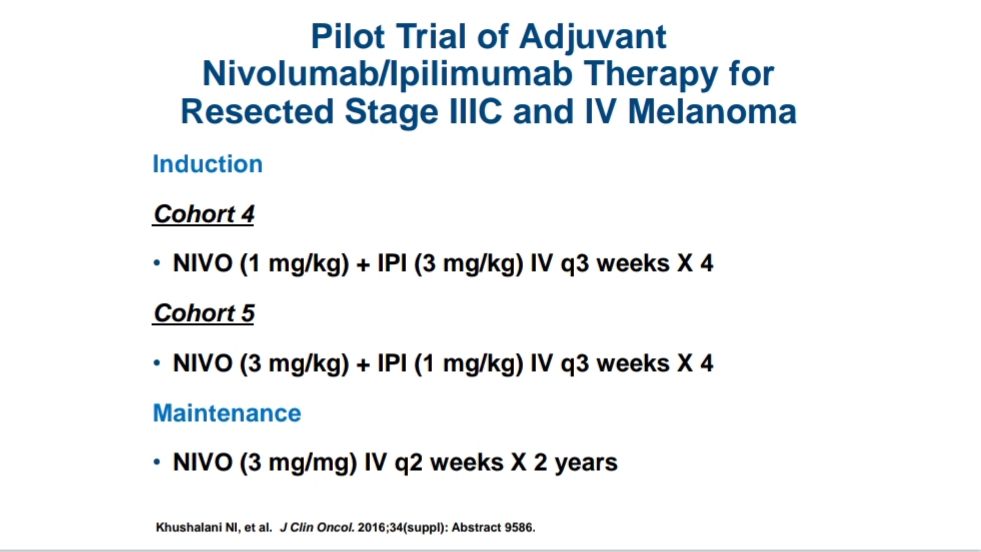
 NEXT - pilot nivo with ipi data justified a new adjuvant trial of nivo + ipi vs nivo with new biomarkers -


Forgive the blurry slides I've reproduced here.  Check the link at the top to view them for yourselves.  Hope this helps.  We've come a long way, though we have further to go.  Coming soon - the furture of immunotherapy for cancer....
Ratties rock! - c

Wednesday, July 3, 2019

IPI/NIVO - results - in melanoma brain mets and long term follow-up in advanced melanoma


Yes.  I think the results ratties provided have finally gotten it through most researchers heads (though not the heads of all oncologists) that targeted therapy (via the BRAF/MEK combo for BRAF positive melanoma peeps) and immunotherapy WORK IN THE BRAIN!!!!  I have been reporting on this trial CheckMate 204 since 2015.  Now, there's this:

Efficacy and safety of the combination of nivolumab (NIVO) plus ipilimumab (IPI) in patients with symptomatic melanoma brain metastases (CheckMate 204).  2019 ASCO.  Tawbi, Forsyth, Hodi...Hamid...Postow, Pavlick...et al. J Clin Oncol 37, 2019 (suppl; abstr 9501)

Background: We previously reported efficacy and safety of NIVO+IPI in patients (pts) with untreated, asymptomatic, melanoma brain metastases (MBM) from the CheckMate 204 study. Here, we provide the first report of NIVO+IPI in pts with symptomatic MBM, and report updated data in pts with asymptomatic MBM. Methods:In this phase II trial, pts with  greater than/= to 1 measurable, nonirradiated MBM 0.5–3.0 cm were enrolled into two cohorts: (1) those with no neurologic symptoms or steroid Rx (asymptomatic; cohort A); and (2) those with neurologic symptoms, whether or not they were receiving steroid Rx (symptomatic; cohort B). In both cohorts, pts received NIVO 1 mg/kg + IPI 3 mg/kg Q3W × 4, then NIVO 3 mg/kg Q2W until progression or toxicity. The primary endpoint was intracranial clinical benefit rate (CBR; proportion of pts with complete response [CR] + partial response [PR] + stable disease [SD]  greater than/= to 6 mo). As of the clinical cutoff date on May 1, 2018, all treated pts (101 in cohort A and 18 in cohort B) had been followed for ~6 mo or longer. Results: In this updated analysis of cohort A (median follow-up of 20.6 mo), the CBR was 58.4% (Table). In cohort B, pts received a median of 1 NIVO+IPI dose and 2 of 18 pts (11%) received all 4 doses. At a median follow-up of 5.2 months in cohort B, intracranial objective response rate was 16.7% and the CBR was 22.2%. Grade 3/4 adverse events occurred in 54.5% of pts in cohort A and in 55.6% of pts in cohort B (6.9% and 16.7% in the nervous system, respectively), with one death related to treatment in cohort A (immune-related myocarditis). Conclusions: In pts with asymptomatic MBM, our updated results show a high rate of durable intracranial responses, further supporting NIVO+IPI as a first-line treatment in this population. Intracranial antitumor activity was observed with NIVO+IPI in pts with symptomatic MBM, but further study is needed to understand the biologic mechanisms of resistance to immunotherapy and to improve treatments in this challenging population. Clinical trial information: NCT02320058

Intracranial response
Asymptomatic
(Cohort A; n = 101)
Symptomatic
(Cohort B; n = 18)
 Best overall response, n (%)


 CR
29 (29)
2 (11)
 PR
26 (26)
1 (5.6)
 SD ≥6 mo
4 (4)
1 (5.6)
CBR, % (95% CI)
58.4 (48.2–68.1)
22.2 (6.4–47.6)

While I am glad to note those responses, you would be hard pressed to convince me to go with ipi/nivo alone...given all we have learned about the positive response systemic therapy COMBINED with radiotherapy provides.  You can read a zillion articles on the combo here:  
Radiation for melanoma

I am not even going to try to note ALL the posts and discussions I have reported regarding the ipi/nivo combo!  We have long known that the 15% response rate to ipi alone and the 40% average response rate to either anti-PD-1 product alone jumps to around 50+% with the ipi/nivo combo.  Just put "ipi/nivo" in the search bar to read the history for yourself.  Now, there's this:

Long-term follow-up of CA209-004: A phase I dose-escalation study of combined nivolumab (NIVO) and ipilimumab (IPI) in patients with advanced melanoma.  2019 ASCO.  Akins, Kirkwood, Wolchok, ..., Postow, ...Sznol.  J Clin Oncol 37, 2019.


Background: We previously reported a 3-year overall survival (OS) rate of 63% with NIVO+IPI concurrent therapy in the initial phase I dose-escalation study for the combination, conducted in patients (pts) with advanced melanoma. Here, we report OS after 5 years of overall study follow-up and assess survival rates after stopping treatment. Methods: Adults with previously treated or untreated unresectable stage III or IV melanoma, and ECOG performance status of 0 or 1, received NIVO + IPI Q3W × 4 as mg/kg in one of the following cohorts: (1) NIVO 0.3 + IPI 3; (2) NIVO 1 + IPI 3; (2a) NIVO 3 + IPI 1; (3) NIVO 3 + IPI 3; (8) NIVO 1 + IPI 3. Cohorts 1-3 received maintenance with NIVO Q3W × 4, then NIVO + IPI Q12W × 8 at assigned doses; cohort 8 received NIVO Q2W for up to 96 weeks. Patients were followed for the primary endpoint of safety and the secondary endpoints of response and progression-free survival for up to 2.5 years, then for the survival exploratory endpoint for up to an additional 3 years, for a maximum study participation of 5.5 years. Results: At a median follow-up of 43.1 months in all cohorts (N = 94), the 4- and 4.5-year OS rates were both 57%. The 4-year OS rates for pts with normal (n = 58) versus elevated LDH (n = 36) were 62% versus 49%; for pts with wild-type (n = 66) and mutant (n = 24) BRAF tumors, 4-year OS rates were 54% and 61%, respectively. Following the last dose of study drug (for any reason), overall post-treatment 1-, 2-, and 3-year OS rates were 74%, 65%, and 56%, respectively; in pts who discontinued due to study drug toxicity (n = 32), post-treatment 1-, 2-, and 3-year OS rates were 84%, 75%, and 65%, respectively, and in pts who discontinued for disease progression (n = 30), these were 52%, 34%, and 24%, respectively. Conclusions: This updated analysis from study CA209-004 showed favorable survival outcomes with NIVO+IPI, regardless of BRAF or LDH status, and provided evidence of long-term survival following discontinuation of treatment in pts with advanced melanoma. Clinical trial information: NCT01024231

Yep.  "...analysis from study CA209-004 showed favorable survival outcomes with NIVO+IPI, regardless of BRAF or LDH status, and provided evidence of long-term survival following discontinuation of treatment in pts with advanced melanoma."  NOW!  Let's make these numbers even better!!!

We are beautiful before, during, and after...


...the storm. ~ c