Showing posts sorted by date for query biomarkers. Sort by relevance Show all posts

Wednesday, December 1, 2021

Circulating tumor DNA (ctDNA) the little bits of tumor floating in our blood and how they can impact melanoma patients

In this post, replete with many links within - Circulating tumor DNA to monitor and predict response in melanoma patients - yes - AGAIN!!!!  - from earlier this year, I wrote:  "I first posted articles related to blood analysis to evaluate circulating tumor DNA in 2014.  It is a fairly non-invasive and relatively painless way to diagnose melanoma, measure tumor burden, and evaluate progression or response in melanoma patients.  It may even indicate those who are more likely to respond to a particular therapy.  Unfortunately, it is not commonly utilized."  Now there are these reports: 

Circulating tumour DNA in patients with advanced melanoma treated with dabrafenib or dabrafenib plus trametinib: a clinical validation study.  Syeda, Wiggins, Corless, et al.  Lancet Oncol.  Feb 2021.

Background: Melanoma lacks validated blood-based biomarkers for monitoring and predicting treatment efficacy. Cell-free circulating tumour DNA (ctDNA) is a promising biomarker; however, various detection methods have been used, and, to date, no large studies have examined the association between serial changes in ctDNA and survival after BRAF, MEK, or BRAF plus MEK inhibitor therapy. We aimed to evaluate whether baseline ctDNA concentrations and kinetics could predict survival outcomes.

Methods: In this clinical validation study, we used analytically validated droplet digital PCR assays to measure BRAFV600-mutant ctDNA in pretreatment and on-treatment plasma samples from patients aged 18 years or older enrolled in two clinical trials. COMBI-d (NCT01584648) was a double-blind, randomised phase 3 study of dabrafenib plus trametinib versus dabrafenib plus placebo in previously untreated patients with BRAFV600 mutation-positive unresectable or metastatic melanoma. Patients had an Eastern Cooperative Oncology Group (ECOG) performance status of 0 or 1. COMBI-MB (NCT02039947) was an open-label, non-randomised, phase 2 study evaluating dabrafenib plus trametinib in patients with BRAFV600 mutation-positive metastatic melanoma and brain metastases. Patients in cohort A of COMBI-MB had asymptomatic brain metastases, no previous local brain-directed therapy, and an ECOG performance status of 0 or 1. Biomarker analysis was a prespecified exploratory endpoint in both trials and performed in the intention-to-treat populations in COMBI-d and COMBI-MB. We investigated the association between mutant copy number (baseline or week 4 or zero conversion status) and efficacy endpoints (progression-free survival, overall survival, and best overall response). We used Cox models, Kaplan-Meier plots, and log-rank tests to explore the association of pretreatment ctDNA concentrations with progression-free survival and overall survival. The effect of additional prognostic variables such as lactate dehydrogenase was also investigated in addition to the mutant copy number.

Findings: In COMBI-d, pretreatment plasma samples were available from 345 (82%) of 423 patients and on-treatment (week 4) plasma samples were available from 224 (53%) of 423 patients. In cohort A of COMBI-MB, pretreatment and on-treatment samples were available from 38 (50%) of 76 patients with intracranial and extracranial metastatic melanoma. ctDNA was detected in pretreatment samples from 320 (93%) of 345 patients (COMBI-d) and 34 (89%) of 38 patients (COMBI-MB). When assessed as a continuous variable, elevated baseline BRAFV600 mutation-positive ctDNA concentration was associated with worse overall survival outcome, independent of treatment group and baseline lactate dehydrogenase concentration, in COMBI-d. A ctDNA cutoff point of 64 copies per mL of plasma stratified patients enrolled in COMBI-d as high risk or low risk with respect to survival outcomes and was validated in the COMBI-MB cohort. In COMBI-d, undetectable ctDNA at week 4 was significantly associated with extended progression-free and overall survival, particularly in patients with elevated lactate dehydrogenase concentrations.

Interpretation: Pretreatment and on-treatment BRAFV600-mutant ctDNA measurements could serve as independent, predictive biomarkers of clinical outcome with targeted therapy.

Circulating tumour DNA and melanoma survival: A systematic literature review and meta-analysis.  Gandini, Zanna, De Angelis, et al.  Crit Rev Oncol Hematol.  Jan 2021.

We reviewed and meta-analysed the available evidence (until December 2019) about circulating tumour DNA (ctDNA) levels and melanoma patients survival. We included twenty-six studies (more than 2000 patients overall), which included mostly stage III-IV cutaneous melanoma patients and differed widely in terms of systemic therapy received and somatic mutations that were searched. Patients with detectable ctDNA before treatment had worse progression-free survival (PFS) and overall survival (OS), with no difference by tumour stage. ctDNA detectability during follow-up was associated with poorer PFS and OS; in the latter case, the association was stronger for stage IV vs. III melanomas. Between-estimates heterogeneity was low for all pooled estimates. ctDNA is a strong prognostic biomarker for advanced-stage melanoma patients, robust across tumour (e.g. genomic profile) and patients (e.g. systemic therapy) characteristics.

The Prognostic Impact of Circulating Tumour DNA in Melanoma Patients Treated with Systemic Therapies-Beyond BRAF Mutant Detection.  Marsavela, Johansson, Pereira, et al.  Cancers (Basel).  Dec 2020.

In this study, we evaluated the predictive value of circulating tumour DNA (ctDNA) to inform therapeutic outcomes in metastatic melanoma patients receiving systemic therapies. We analyzed 142 plasma samples from metastatic melanoma patients prior to commencement of systemic therapy: 70 were treated with BRAF/MEK inhibitors and 72 with immunotherapies. Patient-specific droplet digital polymerase chain reaction assays were designed for ctDNA detection. Plasma ctDNA was detected in 56% of patients prior to first-line anti-PD1 and/or anti-CTLA-4 treatment. The detection rate in the immunotherapy cohort was comparably lower than those with BRAF inhibitors (76%). Decreasing ctDNA levels within 12 weeks of treatment was strongly concordant with treatment response and predictive of longer progression free survival. Notably, a slower kinetic of ctDNA decline was observed in patients treated with immunotherapy compared to those on BRAF/MEK inhibitors. Whole exome sequencing of ctDNA was also conducted in 9 patients commencing anti-PD-1 therapy to derive tumour mutational burden (TMB) and neoepitope load measurements. The results showed a trend of high TMB and neoepitope load in responders compared to non-responders. Overall, our data suggest that changes in ctDNA can serve as an early indicator of outcomes in metastatic melanoma patients treated with systemic therapies and therefore may serve as a tool to guide treatment decisions.

Yep!  THAT LAST SENTENCE!!!

Prognostic Value of ctDNA Mutation in Melanoma: A Meta-Analysis.  Zheng, Sun, Cong, et al.  J Oncol.. May 2021.

Purpose: Melanoma is the most aggressive form of skin cancer. Circulating tumor DNA (ctDNA) is a diagnostic and prognostic marker of melanoma. However, whether ctDNA mutations can independently predict survival remains controversial. This meta-analysis assessed the prognostic value of the presence or change in ctDNA mutations in melanoma patients.

Methods: We identified studies from the PubMed, EMBASE, Web of Science, and Cochrane databases. We estimated the combined hazard ratios (HRs) for overall survival (OS) and progression-free survival (PFS) using either fixed-effect or random-effect models based on heterogeneity.

Results: Sixteen studies including 1,781 patients were included. Both baseline and posttreatment detectable ctDNA were associated with poor OS. For PFS, baseline detectable ctDNA may be associated with adverse PFS and baseline high ctDNA and increased ctDNA were significantly associated with adverse PFS. The baseline BRAFV600 ctDNA mutation-positive group was significantly associated with adverse OS compared with the baseline ctDNA-negative group. There were no significant differences in PFS between the baseline BRAFV600 ctDNA mutation-detectable group and the undetectable group.

Conclusion: The presence or elevation of ctDNA mutation or BRAFV600 ctDNA mutation was significantly associated with worse prognosis in melanoma patients.

Liquid biopsy and radiological response predict outcomes following discontinuation of targeted therapy in patients with BRAF mutated melanoma. Di Guardo, Randon, Corti, et al.  Oncologist. August 2021.

Background: Outcomes of patients with metastatic melanoma discontinuing BRAF-targeted therapy for cumulative toxicity after sustained response are unknown.

Patients and methods: This retrospective case series analysis conducted at a single Cancer Center in Italy included patients with BRAF mutated metastatic melanoma treated with a BRAF inhibitor as a single agent or in combination with a MEK inhibitor between June 1, 2011 and January 1, 2020 and interrupting treatment after achieving complete response (CR) or long-lasting partial response (PR - i.e. greater than 12 months) due to cumulative toxicity.

Results: We included 24 patients with a median treatment duration of 59.4 months. CR and PR were achieved in 71% and 29% of patients, respectively. At a median follow-up after treatment discontinuation of 37.8 months, 12-months progression free survival after discontinuation (dPFS) rate was 70.8% and 24-months dPFS rate was 58.3%. Baseline patients and tumor characteristics as well as treatment duration and best response did not significantly impact on dPFS. Patients with CR and negative circulating tumor DNA (ctDNA) at time of discontinuation had a significantly improved dPFS compared to patients with either radiological residual disease or ctDNA positivity. No patient in CR with undetectable ctDNA experienced progression.

Conclusion: The risk of progression is high even in patients with sustained sensitivity to BRAF/MEK inhibitors. Integration of liquid biopsy in clinical trials investigating optimal management of patients with sustained sensitivity to BRAF/MEK inhibitors is warranted.

Implications for practice: Outcomes of patients with metastatic melanoma discontinuing BRAF-targeted therapy for cumulative toxicity are unknown. We analyzed patients with sustained responses (median treatment duration 59.4 months). Twelve and 24-months progression free survival following discontinuation were 70.8% and 58.3% respectively. Complete response and negative ctDNA at time of discontinuation are promising prognostic biomarkers in this setting.

Detection of clinical progression through plasma ctDNA in metastatic melanoma patients: a comparison to radiological progression.  Marsavela, McEvoy, Pereira, et al.  Br J Cancer.  August 2021.

Background: The validity of circulating tumour DNA (ctDNA) as an indicator of disease progression compared to medical imaging in patients with metastatic melanoma requires detailed evaluation.

Methods: Here, we carried out a retrospective ctDNA analysis of 108 plasma samples collected at the time of disease progression. We also analysed a validation cohort of 66 metastatic melanoma patients monitored prospectively after response to systemic therapy.

Results: ctDNA was detected in 62% of patients at the time of disease progression. For 67 patients that responded to treatment, the mean ctDNA level at progressive disease was significantly higher than at the time of response. However, only 30 of these 67 (45%) patients had a statistically significant increase in ctDNA by Poisson test. A validation cohort of 66 metastatic melanoma patients monitored prospectively indicated a 56% detection rate of ctDNA at progression, with only two cases showing increased ctDNA prior to radiological progression. Finally, a correlation between ctDNA levels and metabolic tumour burden was only observed in treatment naïve patients but not at the time of progression in a subgroup of patients failing BRAF inhibition (N = 15).

Conclusions: These results highlight the low efficacy of ctDNA to detect disease progression in melanoma when compared mainly to standard positron emission tomography imaging.

I think the vast preponderance of the evidence shows that knowing the presence of and/or quantity of bits of melanoma floating in your blood stream gives the patient and their physician important information that can impact treatment choice.  That same data can help make decisions about whether or not to stop or change treatments.  Many studies have demonstrated that this simple blood draw can tell you your status weeks to months sooner than tumors can be seen on radiographic studies.  The last study above stands in contrast to that but I try to be complete.  I will say that it is important to note that the study above was a retrospective review of 108 blood samples collected at the time of disease progression vs 66 patients monitored after response to systemic therapy.  I don't think that is the best way to collect and compare data - maybe that's just me.  I leave you with this ~

The prognostic value of circulating tumor DNA in patients with melanoma: A systematic review and meta-analysis.  Feng, Cen, Tan, et al.  Transl Oncol.  June 2021.

Background: Circulating tumor DNA (ctDNA) has been investigated as a potential prognostic biomarker to evaluate the therapeutic efficacy and disease progression in melanoma patients, yet results remain inconclusive. The purpose of this study was to illustrate the prognostic value of ctDNA in melanoma.

Objectives: To describe the clinical prognostic value of ctDNA for melanoma patients.

Methods: Searched for eligible articles from Pubmed, Web of Science and Embase. Pooled hazard ratios (HRs) and 95% confidence intervals (CIs) were calculated to evaluate the association between ctDNA at baseline or during treatment and overall survival (OS) and progression-free survival (PFS).

Results: A total of 9 articles were obtained, involving 617 melanoma patients. The pooled HRs revealed that compared with baseline undetectable ctDNA patients, detectable ctDNA was highly correlated with poor OS and PFS. A meta-analysis of these adjusted HRs was performed and confirmed that ctDNA collected at baseline was associated with poorer OS/PFS. During treatment, a significant association was shown between ctDNA and poorer OS/PFS.

Conclusion: Investigation and application of ctDNA will improve "liquid biopsy" and play a role in early prediction, monitoring disease progression and precise adjusting treatment strategies in melanoma patients.

For me, I think ctDNA can provide valuable information that we can use when having to make the incredibly difficult decisions faced by cancer patients.  Coming soon - putting my money and my blood - where my mouth is. Hang tough. - c 

Monday, June 28, 2021

Adjuvant therapy for melanoma - a history, the latest from ASCO 2021 and a remembering...

 I have been screaming about the need for adjuvant care since I became Stage IV with a zapped brain met and surgically removed lung met in April 2010 and could not attain a position in ongoing ipi trials because I had "no measurable disease".  After yet another met (surgically removed) to a tonsil in October of that year, I did gain placement in the adjuvant arm of a nivo trial being run by Weber (then of Moffitt in Tampa) that December.  Here's the report on how I and my 30 fellow ratties did, published in 2014:  C'est moi!!! Results from the 33 ratties in my Nivolumb/Opdivo trial...published!  

Since then, both targeted and immunotherapy have been FDA approved as adjuvant treatments for Stage III and IV melanoma patients. Here is a post with a break down of the science and FDA approvals from 2020:  ADJUVANT therapy for melanoma!!!!!!!!!!!!!! State of the science....  Here are a zillion additional posts, filled with the science, data and rants: All things Adjuvant 

Now there are these reports from earlier this year:

Novel adjuvant options for cutaneous melanoma.  Dimitriou, Long, Menzies.  Ann Oncol.  March 2021.

Background: Patients with resected stage III and IV melanoma have a high risk of recurrence. As the outcomes for patients with metastatic disease have improved dramatically over the past decade due to systemic therapy, more recently so too have the outcomes of patients with resected stage III and IV melanoma with the introduction of checkpoint inhibitor immunotherapy and targeted therapy in the adjuvant setting.

Results: Anti-programmed cell death protein 1 monotherapy and BRAF/MEK inhibitors are currently deemed standard of care for resected stage III melanoma. For patients with stage IIIB melanoma, 2-year and 3-year recurrence-free survival is approximately 72% and 65% for nivolumab, 70% and 65.7% for pembrolizumab and 68% and 60% for dabrafenib/trametinib, respectively. For stage IIIC  melanoma, 2-year and 3-year recurrence-free survival is 60% and 53.5% for nivolumab, 60% and 54.3% for pembrolizumab and 59% and 47% for dabrafenib/trametinib, respectively. Adjuvant treatment is recommended for patients with stage IIIB-IIID melanoma, and may be considered for patients with stage IIIA melanoma. For resected stage IV, nivolumab is the only approved agent; however, recent results from a phase II clinical trial show promising efficacy for combined ipilimumab and nivolumab as well. Long-term data are required to determine which therapy has the greatest impact on overall survival. Schedules, delivery and toxicity are also important factors to consider when selecting adjuvant treatment.

Conclusions: Randomized studies of patients with resected high-risk melanoma have shown that immunotherapy or targeted therapy improve recurrence-free survival compared with placebo/ipilimumab. In order to optimize these treatments, prognostic and predictive biomarkers, as well as strategies to reduce treatment-related toxicities and overcome resistance, are required. 

Adjuvant Therapy of High-Risk (Stages IIC-IV) Malignant Melanoma in the Post Interferon-Alpha Era: A Systematic Review and Meta-Analysis.  Christofyllakis, Pföhler, Bewarder, et al. Front Oncol.  Feb 2021.

Introduction: Multiple agents are approved in the adjuvant setting of completely resected high-risk (stages IIC-IV) malignant melanoma. Subgroups may benefit differently depending on the agent used. We performed a systematic review and meta-analysis to evaluate the efficiency and tolerability of available options in the post interferon era across following subgroups: patient age, stage, ulceration status, lymph node involvement, BRAF status.

Methods: The PubMed and Cochrane Library databases were searched without restriction in year of publication in June and September 2020. Data were extracted according to the PRISMA Guidelines from two authors independently and were pooled according to the random-effects model. The predefined primary outcome was recurrence-free survival (RFS). Post-data extraction it was noted that one trial (BRIM8) reported disease-free survival which was defined in the exact same way as RFS.

Results: Five prospective randomized placebo-controlled trials were included in the meta-analysis. The drug regimens included ipilimumab, pembrolizumab, nivolumab, nivolumab/ipilimumab, vemurafenib, and dabrafenib/trametinib. Adjuvant treatment was associated with a higher RFS than placebo. Nivolumab/ipilimumab in stage IV malignant melanoma was associated with the highest RFS benefit, followed by dabrafenib/trametinib in stage III BRAF-mutant melanoma. The presence of a BRAF mutation was associated with higher RFS rates compared to the wildtype group. Patient age did not influence outcomes. Immune checkpoint inhibitor monotherapy was associated with lower RFS in non-ulcerated melanoma. Patients with stage IIIA benefited equally from adjuvant treatment as those with stage IIIB/C. Nivolumab/ipilimumab and ipilimumab monotherapy were associated with higher toxicity.

Conclusion: Adjuvant therapy should not be withheld on account of advanced age or stage IIIA alone. The presence of a BRAF mutation is prognostically favorable in terms of RFS. BRAF/MEK inhibitors should be preferred in the adjuvant treatment of BRAF-mutant non-ulcerated melanoma.

Melanoma recurrence patterns and management after adjuvant targeted therapy: a multicentre analysis.  Bhave, Pallan, Long, et al.  Br J Cancer.  Feb 2021.

Background: Adjuvant targeted therapy (TT) improves relapse free survival in patients with resected BRAF mutant stage III melanoma. The outcomes and optimal management of patients who relapse after adjuvant TT is unknown.

Methods: Patients from twenty-one centres with recurrent melanoma after adjuvant TT were included. Disease characteristics, adjuvant therapy, recurrence, treatment at relapse and outcomes were examined.

Results: Eighty-five patients developed recurrent melanoma; nineteen (22%) during adjuvant TT. Median time to first recurrence was 18 months and median follow-up from first recurrence was 31 months. Fifty-eight (68%) patients received immunotherapy (IT) or TT as 1st line systemic therapy at either first or subsequent recurrence and had disease that was assessable for response. Response to anti-PD-1 (±trial agent), combination ipilimumab-nivolumab, TT rechallenge and ipilimumab monotherapy was 63%, 62% 25% and 10% respectively. Twenty-eight (33%) patients had died at census, all from melanoma. Two-year OS was 84% for anti-PD-1 therapy (±trial agent), 92% for combination ipilimumab and nivolumab, 49% for TT and 45% for ipilimumab monotherapy.

Conclusions: Patients who relapse after adjuvant TT respond well to subsequent anti-PD-1 based therapy and have outcomes similar to those seen when first line anti-PD-1 therapy is used in stage IV melanoma.

And these out of ASCO:

Management of resected stage III/IV melanoma with adjuvant immunotherapy.  Johnson, Atkinson, Bhave, et al.  ASCO 2021. 

Background:  Adjuvant anti-PD1 therapy reduces the risk of recurrence in resected stage III/IV melanoma and is now standard care. Limited data exist beyond registration trials. We sought to explore the use of adjuvant immunotherapy in routine clinical practice.

Methods:  Patients (pts) from 11 Australian centres who received adjuvant nivolumab (nivo) for resected stage III/IV melanoma were included in this study. Efficacy, toxicity, surveillance, recurrence characteristics, management and further treatment outcomes were examined.

Results: 471 pts received adjuvant nivo between 8/2018 to 3/2020. 318 (68%) were male, median age 64y (range 17-94), 28 (6%) were AJCC v8 IIIA, 194 (41%) IIIB, 175 (37%) IIIC, 11 (2%) IIID, and 63 (13%) IV. 65 (14%) pts had in-transit only disease, 152 (37%) pts were sentinel lymph node biopsy (SLNB+) and only 9 (6%) of these had CLND. 128 (27%) had BRAF mutant (BRAFmt) melanoma. Median time from resection to start of adjuvant nivo was 1.8 months (mo) (range 0.2-4.0). Median FU was 17.5 mo. 256 (54%) pts completed 12 months of nivo, 86 (18%) ceased early for toxicity, 76 (16%) for disease recurrence, 25 (5%) other reasons (COVID-19 8, co-morbidities 7, pt choice 10); 28 (6%) pts were still receiving nivo at data cut. Median duration of treatment was 10.4 mo (range 0-16.8). 117 (25%) pts recurred; 76 (65%) while ON nivo and 41 (35%) OFF nivo (greater than 1 month after last dose, including 20 pts who stopped early for toxicity). 24 mo RFS was 69%. Median time to recurrence was 6.0 mo. 56 (48%) had first recurrence with locoregional (LR) disease only and 61 (52%) had distant +/- LR recurrence. Of those who recurred with LR disease only, 46/56 (82%) underwent surgery, 15/46 (33%) then had adjuvant radiotherapy, and 15/46 (33%) had ‘second adjuvant’ therapy with BRAF/MEK inhibitors (15/21, 71% BRAFmt pts). 10/56 (37%) pts who recurred with LR disease subsequently recurred distantly. 58/80 (73%) pts received systemic therapy at either 1st or subsequent unresectable recurrence. For recurrences ON nivo, 18 pts received combination ipilimumab (ipi) and nivo (ORR 44%), 4 pts had ipi monotherapy (ORR 0%), 7 pts had anti-PD1 + investigational agent (ORR 57%), 11 pts had BRAF/MEK inhibitors (ORR 82%). 1 pt had PD with ongoing PD1 monotherapy. For recurrences OFF nivo, no patients responded to PD1 alone (n = 1) or with an investigational agent (n = 1), ipi+nivo (n = 3), ipi monotherapy (n = 4) or chemotherapy (n = 2); 6 pts received BRAF/MEK inhibitors (ORR 50%). 2-year OS was 92%.

Conclusions: Despite higher rates of discontinuation due to toxicity compared with clinical trial cohorts, the efficacy data appear similar. Most early recurrences are distant, and many with LR recurrence soon recur distantly thereafter. Second line adjuvant BRAF/MEK inhibitors are frequently used for resected LR recurrence. Both ipi+nivo and BRAF/MEK inhibitors appear to have activity after distant recurrence.

Final analysis of overall survival (OS) and relapse-free-survival (RFS) in the intergroup S1404 phase III randomized trial comparing either high-dose interferon (HDI) or ipilimumab to pembrolizumab in patients with high-risk resected melanoma. Grossmann, Othus, Patel, et al.  ASCO 2021. 

Background:   We assessed whether or not adjuvant pembrolizumab given over 1 year would improve OS and RFS in comparison to high dose ipilimumab (ipi10) or HDI - the two FDA-approved adjuvant treatments for high risk resected melanoma at the time of study design.

Methods:  Patients age 18 or greater with resected stages IIIA(N2), B, C and IV were eligible. Patients with CNS metastasis were excluded. [SO OVER THIS!!!!!!!!!!!!!!]  At entry, patients must have had complete staging and adequate surgery to render them free of melanoma including completion lymph node dissection for those with sentinel node positive disease. Prior therapy with PD-1 blockade, ipilimumab or interferon was not allowed. Two treatment arms were assigned based on stratification by stage, PD-L1 status (positive vs. negative vs. unknown), and intended control arm (HDI vs. Ipi10). Patients enrolled between 10/2015 and 8/2017 were randomized 1:1 to either the control arm [(1) interferon alfa-2b 20 MU/m2 IV days 1-5, weeks 1-4, followed by 10 MU/m2/d SC days 1, 3, and 5, weeks 5-52 (n=190), or (2) ipilimumab 10 mg/kg IV q3w for 4 doses, then q12w for up to 3 years (n=465)], or the experimental arm [pembrolizumab 200 mg IV q3w for 52 weeks (n=648)]. The study had three primary comparisons: 1) RFS among all patients, 2) OS among all patients, 3) OS among patients with PD-L1+ baseline biopsies. 

Results: 1,426 patients were screened and 1,345 patients were randomized with 11%, 49%, 34%, and 6% AJCC7 stage IIIA(N2), IIIB, IIIC and IV, respectively. This final analysis was performed per-protocol 3.5 years from the date the last patient was randomized, with 512 RFS and 199 OS events. The pembrolizumab group had a statistically significant improvement in RFS compared to the control group (pooled HDI and ipi10) with HR 0.740 (99.618% CI, 0.571 to 0.958). There was no statistically significant improvement in OS in the 1,303 eligible randomized overall patient population with HR 0.837 (96.3% CI, 0.622 to 1.297), or among the 1,070 (82%) patients with PD-L1 positive baseline biopsies with HR 0.883 (97.8% CI, 0.604 to 1.291). Gr 3/4/5 event rates were as follows: HDI 69/9/0%, ipi10 43/5/0.5% and pembrolizumab 17/2/0.3%.

Conclusions:  Pembrolizumab improves RFS but not OS compared to HDI or ipi10 in the adjuvant treatment of patients with high-risk resected melanoma. Pembrolizumab is a better tolerated adjuvant treatment regimen than HDI or Ipi10.  Clinical trial information: NCT02506153.

See study below! 

Propensity weighted indirect treatment comparison of nivolumab (NIVO) versus placebo (PBO) as adjuvant therapy for resected melanoma: A number needed to treat and overall survival analysis.  Weber, Poretta, Stwalley, et al.  ASCO 2021.

Background:  The CheckMate 238 trial demonstrated that NIVO improved recurrence free survival (RFS) vs. ipilimumab (IPI). The EORTC 18071 trial demonstrated that IPI improved RFS and overall survival (OS) vs. PBO. The current study pooled data from these two trials to indirectly assess the RFS and OS of NIVO vs. PBO and the numbers needed to treat (NNTs) for one additional recurrence-free survivor and survivor over 4 years.

Methods:  Patients with resected AJCC 7th edition stage IIIB/C cutaneous melanoma from CheckMate 238 (NIVO vs. IPI) and EORTC 18071 (IPI vs. PBO) were pooled together with inverse probability weighting to balance between-trial differences in baseline characteristics. NNTs were calculated for RFS and OS comparing NIVO vs. IPI and PBO over 4 years. To account for improved post-recurrence survival over time, a sensitivity analysis that adjusted for post-recurrence survival in the PBO arm of EORTC 18071 was performed.

Results:   A total of 278, 643, and 365 patients treated with NIVO, IPI, and PBO, respectively, were included. In the weighted samples, patients treated with NIVO had consistently higher RFS rates than those treated with IPI (HR [95% CI]: 0.69 [0.56, 0.85]) and PBO (HR: 0.49 [0.39, 0.61]). NIVO was associated with similar OS as IPI (HR: 0.80 [0.60, 1.08]) and superior OS compared to PBO (HR: 0.45 [0.33, 0.60]). At 4 years, the weighted RFS rate was 53.1% for NIVO, 41.8% for IPI, and 29.1% for PBO. The NNT to achieve one additional recurrence-free survivor was 4.2 for NIVO vs. PBO and 8.9 for NIVO vs. IPI. The NNT to obtain one additional survivor was 4.8 for NIVO vs. PBO and 22.2 for NIVO vs. IPI. The OS rate for PBO after adjusting for differences in post-recurrence treatments at 4 years was 64.1%, and the corresponding NNT of OS comparing NIVO vs. adjusted PBO was 8.5.

Conclusions:  In patients with resected AJCC 7th edition stage IIIB/C cutaneous melanoma, this indirect comparison showed that NIVO improved RFS and OS vs placebo, with OS improvement maintained after adjustment for post-recurrence therapy.

Like so much in melanoma, adjuvant therapy is not a sure thing.  Still, I am certain adjuvant nivo saved my life as a Stage IV patient spiraling into met after met in untenable physiologic locations.  

Thanks to all the mice and ratties who light our way.  I continue to hold ever so many, to whom my debt of gratitude will never be repaid, in my heart.  A few are remembered here ~ Oh, the people you'll meet...

And here:  Artie...a beautiful soul, an amazing knight. Merde!

And here:  Heavy heart, heavy lifting ~ for he was all of us...

I sill think of Steven, Joshie and all the others.  And today, news that I will never meet our dear Julie in person.  Even so, I will love her still, forever in appreciation of her wide smile, her incredible goodness and common sense.  I imagine she is looking down on us, from a beautiful vista, alongside her beloved camper that will never need repairs, on trips unspoiled by earthly troubles.  Be at peace, my dear friend.  We will always love you. Shalom. ~ les

Thursday, June 24, 2021

New treatments - kinda. Anti-LAG-3 plus anti-PD-1 to boost response. Ipi/nivo plus tocilizumab to decrease side effects.

Unfortunately, as mentioned in yesterday's post, current melanoma treatments do not meet the needs of all melanoma patients.  Also as mentioned, a great deal of current research is building on existing immunotherapies - attempting to fortify response rates by adding a wide variety of pharmaceuticals to existing products.

Here is another study looking at combining an anti-LAG-3 product with yet another anti-PD-1 product: (Note:  Yesterday's post includes a link to previous data and info about anti-LAG-3 generally.)

Clinical activity of fianlimab (REGN3767), a human anti-LAG-3 monoclonal antibody, combined with cemiplimab (anti-PD-1) in patients (pts) with advanced melanoma.  Hamid, Wang, Kim, et al.  ASCO 2021.

Background:  Fianlimab and cemiplimab are two high-affinity, fully human, hinge-stabilized IgG4 monoclonal antibodies. In a Phase 1 dose escalation study, fianlimab combined with cemiplimab showed an acceptable safety profile and some clinical activity in pts with advanced malignancies. Here, we present safety and clinical activity data from two expansion cohorts of pts with advanced melanoma (anti–programmed cell death/ligand-1 [anti–PD-(L)1] naïve or experienced) who were treated with fianlimab + cemiplimab and had an opportunity for first on-treatment tumor assessment (cut-off date: Jan 4, 2021).

Methods:  Pts with advanced melanoma who had no prior anti–PD-(L)1 treatment (naïve) or prior anti–PD-(L)1 treatment within 3 months of screening (experienced) received fianlimab 1600 mg + cemiplimab 350 mg by IV infusion every 3 weeks. Tumor measurements were performed every 6 weeks for the first 24 weeks and subsequently every 9 weeks per RECIST v1.1.

Results:  48 pts with advanced melanoma were treated with the combination therapy: 33 were anti–PD-(L)1 naïve and 15 were anti–PD-(L)1 experienced (median age: 69 years vs 59 years; male: 66.7% vs 46.7%; Caucasian: 87.9% vs 60%). The safety profile (including immune-related adverse events [AEs]) of fianlimab + cemiplimab combination therapy was similar to that of anti–PD-1 monotherapy with one exception. The rate of adrenal insufficiency, 8.3% (4/48) of pts, is similar to the rate previously observed with anti–PD-1 + anti–cytotoxic T-lymphocyte-associated protein 4 (CTLA-4) combination therapy but higher than that observed with anti–PD-1 monotherapy. Grade greater than/= to treatment-emergent AEs (TEAEs) occurred in 35.4% (17/48) of patients; Grade greater than/= to serious TEAEs occurred in 22.9% (11/48) of patients; 8.3% (4/48) of patients discontinued treatment due to a TEAE. The most common TEAEs were fatigue (n = 15, 31.3%) and rash (n = 11, 22.9%). By investigator assessment, objective response rate (includes unconfirmed complete [CR] and partial responses [PR]) was 63.6% (3 CRs and 18 PRs) for anti–PD-(L)1 naïve pts and 13.3% (1 CR and 1 PR) for anti–PD-(L)1 experienced pts. Median progression-free survival and median duration of response for the anti–PD-(L)1 treatment naïve cohort have not been reached. Prognostic clinical markers and tumor biomarkers such as expression of LAG-3, PD-L1, and major histocompatibility complex II are being evaluated. Recruitment is ongoing.

Conclusions:  The safety profile of fianlimab + cemiplimab is similar to that observed with cemiplimab monotherapy and other anti–PD-1s, with the exception of higher rate of adrenal insufficiency. Fianlimab + cemiplimab combination has shown clinical activity for pts with advanced melanoma that is similar to anti–PD-1 + CTLA-4 combination therapy, but with lower demonstrated rates of TEAEs. Clinical trial information: NCT03005782.

Fingers crossed!

With its 50%+ response rate and durable results, the ipi/nivo combo has thus far been the best thing going for melanoma patients.  However, side effects caused by the treatment force roughly 40% of patients to discontinue therapy. (With that in mind, you may find this report from 2017 of interest:  40% of melanoma patients stop ipi/nivo due to side effects...BUT...efficacy is about the same!!!)  Anyhow, in an effort to DECREASE those side effects, this trial is adding tocilizumab - a monoclonal antibody that blocks interleukin 6 and is often used to treat rheumatoid arthritis - to the combo.  Interesting too, to look back on the addition of leflunomide (another drug used for RA) to targeted therapy as noted in this post:  An anti-rheumatic drug that increases the effect of vemurafenib and selumetinib?)  

Ipilimumab, nivolumab and tocilizumab as first-line therapy for advanced melanoma.  Mehmi, Hamid, Hodi, et al.  ASCO 2021.

Background:  Interleukin 6 (IL-6) functions in the maintenance of hepatocytes, haemotopoietic progenitor cells, a variety of other tissues, and regulates the innate and adaptive immune system. IL-6 may play a role as a chronic inflammatory mediator in altering levels of acute phase proteins synthesized by the liver and circulating myeloid cells which have been shown to be associated with short survival with checkpoint inhibition and which are immune suppressive. The immunomodulatory properties of interleukin-6 may in part also be responsible for immune related adverse events, given the reversal of those toxicities observed with IL-6 receptor blockade in clinical practice. To assess if blockade of IL-6 binding is associated with a decrease in irAEs and/or an increase in efficacy defined as overall response rate (ORR) at week 24 in patients receiving ICB, we added tocilizumab to ipilimumab and nivolumab therapy.

Methods:  The current phase II trial is a two-stage design to assess the safety, tolerability, and grades 3-5 immune related toxicities of tocilizumab administered every 6 weeks up to week 24 in combination with ipilimumab at 1 mg/kg and nivolumab at 3 mg/kg every 3 weeks for 4 doses each during a 12 week induction period, then administered every 6 weeks with nivolumab at 240 mg flat dose every 2 weeks in maintenance for up to 24 weeks, and nivolumab alone will be given at 480 mg flat dose every 4 weeks thereafter for up to 2 years. Eligible patients include those age 18 or older with measurable and unresectable stages III/IV melanoma (cutaneous, acral, mucosal), without prior systemic treatment for metastatic disease. Adjuvant therapy (IFN-alpha, ipilimumab and/or nivolumab, or pembrolizumab) is allowed. Patients with metastatic melanoma of brain are allowed, if neurologically stable and off immunosuppressive steroids. A total of 18 patients will be treated in the first stage, and 49 additional patients in the second stage for a total of 67. The comparator data are from the N3I1 arm of Checkmate-511 trial, in which treatment-related grades 3-5 irAEs were 33.9% with a 45.6% response rate (1). Prespecified activity goal for the first stage of accrual has been met; second stage accrual began in January 2021.  Clinical trial information: NCT03999749.

For what it's worth.  - c

P.S. With great thanks to the Edster - this link, that includes an explanatory video from the Wizard Weber, gives important background on the whys and wherefores related to IL-6 in this instance and indicates that adding an IL-6 blockade may not only decrease side effects from immunotherapy but ADD effectiveness - Elevated Levels of Serum CRP and IL-6 Are Biomarkers of Poor Prognosis in Patients Receiving Immune Checkpoint Inhibitors.  Gotta love a man in a bow tie who can elucidate the difference between predictive and prognostic!!!!  - c

Friday, July 10, 2020

Skin rashes, vitiligo and prognosis when on immunotherapy for melanoma


I have shared many research articles and posts on vitiligo:  A zillion reports on vitiligo

Now, there are these ~

Correlation between cutaneous adverse events and prognosis in patients with melanoma treated with nivolumab: A single institutional retrospective study.  Nakano, Takahashi, Namikawa, et al.  J Dermatol.  2020 Mar 11.


Treatment for patients with unresectable melanoma has been dramatically changed by the use of immunocheckpoint inhibitors (ICI). In this study, we reviewed patients with unresectable stage III/IV melanoma, who were treated with nivolumab between July 2014 and March 2017 at the Department of Dermatologic Oncology, National Cancer Center Hospital, Tokyo, and retrospectively recorded cutaneous adverse events (cAE), development of vitiligo, clinical characteristics and clinical responses. We identified 128 patients, 61 (47.7%) of whom showed cAE, including 30 (23.4%) with development or exacerbation of vitiligo. The prognosis of patients with melanoma treated with ICI correlated with cAE, including development of vitiligo. Patients with cAE showed better objective responses (41.0% vs 6.0%), progression-free survival (PFS) (377 vs 61 days) and overall survival (OS) (763 vs 209 days) than did patients without cAE. Patients who developed vitiligo showed better objective responses (53.3% vs 29.0% vs 6.0%), PFS (median, not reached vs 317 vs 65 days) and OS (not reached vs 689 vs 209 days) than did patients with other cAE and patients without cAE. Landmark analysis showed development of vitiligo starting 20 weeks after starting nivolumab correlated with better OS. In multivariate analysis, OS correlated with performance status, number of metastasized organs, cAE other than vitiligo and development of vitiligo. Despite the fact that the correlation between other cAE and OS was less than that of vitiligo, cAE may be a simple marker of favorable prognosis.

Vitiligo expansion and extent correlate with durable response in anti-programmed death 1 antibody treatment for advanced melanoma: A multi-institutional retrospective study.  Matsuya, Nakamura, Matsushita, et al.  Dermatol. 2020 Apr 10. 


Vitiligo is an autoimmune disorder resulting from the destruction of melanocytes. Several reports indicate the association between vitiligo and treatment response in advanced melanoma during immunotherapy. It has not been investigated, however, if an increase of vitiligo while on treatment with anti-programmed death 1 (PD-1) antibodies is associated with more durable responses. The aim of this study is to evaluate the correlation between the vitiligo dynamics and clinical efficacy of anti-PD-1 antibodies. This study included advanced melanoma patients who were treated with nivolumab or pembrolizumab and developed vitiligo thereafter. Correlation between vitiligo expansion (defined as an increase of lesion size at two separate time points at least 4 weeks apart) as well as vitiligo extent (body surface area [BSA] affected) and clinical efficacy based on response rate, progression-free survival and overall survival was assessed. We retrospectively reviewed 29 patients. The median time from the initiation of anti-PD-1 antibody to vitiligo onset was 4.3 months in patients who showed a response and 5.5 months in patients who showed no response. Twelve patients showed vitiligo expansion, and in nine of these patients, vitiligo increased to grade 2 (covering greater than/= to 10% BSA). Vitiligo expansion and grade 2 vitiligo showed no improvement in treatment response but were associated with prolonged progression-free survival. Grade 2 vitiligo also showed a trend for prolonged overall survival. Trend of expansion and larger vitiligo extent may be predictive factors of prolonged survival during anti-PD-1 antibody in melanoma patients.


Vitiligo and Melanoma-Associated Vitiligo: Understanding Their Similarities and Differences.  Cohen, Manga, Lin and Elbuluk.  Am J Clin Dermatol.  2020 May 28.  
Background: There has been a significant increase in the number and efficacy of therapies for advanced melanoma. Immunotherapies, such as anti-cytotoxic T-lymphocyte antigen-4 and programmed cell death-1 inhibitors, have improved the prognosis for patients with advanced melanoma. While spontaneous melanoma-associated vitiligo is a known phenomenon, the occurrence of melanoma-associated vitiligo following melanoma therapy is now recognized to associate with favorable outcomes.  
Objective: The objective of this article is to provide a comprehensive literature review of melanoma-associated vitiligo and explore the insights these findings provide about the pathobiology of vitiligo and mechanisms underlying melanoma therapies.  
Methods: PubMed and Science Direct databases were searched for studies pertaining to melanoma-associated vitiligo. The 36 studies reviewed included meta-analyses (n = 2), prospective cohort studies (n = 4), prospective observational studies (n = 3), retrospective studies (n = 12), case series (n = 2), and case reports (n = 13).  
Results: The basic mechanisms underlying melanoma-associated vitiligo and vitiligo may be shared. Characterization of these mechanisms will identify new biomarkers and therapeutic targets for both melanoma and vitiligo.  
Conclusions: Co-opting the immune system to target tumor antigens highlights the potential overlap between anti-tumor immunity and autoimmunity. The development of vitiligo-like depigmentation in association with immunotherapy for melanoma may provide insights into both the immune response against melanoma as well as the pathogenesis of vitiligo.
Here's to a whiter shade of pale! - c

Wednesday, April 8, 2020

The future of immunotherapy and cancer - per Weber


To finish my prior link, I'll share the remainder of Dr. Weber's report with you.  Check it out for yourself here -  Immunotherapy for cancer: the journey so far, and where are we headed? Cancer Crosslinks 2018 Jeffrey S Weber MD PhD

Advances in immunotherapy has benefited those experiencing a variety of cancers, not just melanoma:


Then there is the future.  Researchers are looking at ways to overcome resistance:


Work continues on successful vaccines that immunize against neo-antigens:


Efforts are being made to make adoptive cell therapy (ACT) with genetically modified T cells and tumor infiltrating lymphocytes more practical and economical:


New therapies and combinations are being developed:


The work to develop biomarkers that accurately predict outcomes continues:


So grateful to this man on a personal level with admiration for all of those who dedicate their lives to the care of and research for others.  It benefits us all.  - c

Thursday, March 26, 2020

ADJUVANT therapy for melanoma!!!!!!!!!!!!!! State of the science....


Over the next bit, I am going to be digging into a presentation by Dr. Jeffrey Weber - see it for yourself here:  Immunotherapy for cancer: the journey so far, and where are we headed? Cancer Crosslinks 2018

With so many Stage III melanoma patients now gaining access to adjuvant care and all the inherent questions pertinent to that, combined with the fact that adjuvant treatment is what I attained for my melanoma journey, albeit as a Stage IV patient, I will start there.  Before we get into the weeds, here is an overview of current approved therapies for melanoma I wrote in 2017 that sadly, other than a change in dosing options for the administration of Opdivo, has not needed any significant updates since:  Melanoma Intel: A primer for current standard of care and treatment options
Here is an article that does pretty much the same thing, written in 2018:  Melanoma treatment in review

LATE ADDENDUM:  FINALLY!!!! There was reason to update the primer - April 2022 - Primer for Current Melanoma Treatments - New and Improved Version 2022!!!!

I recently penned some information for a Stage III patient dealing with the confusion that a melanoma diagnosis and adjuvant treatment can engender, and it seems a pretty good place to start:

It is very easy to get confused with all the "data" floating around.  Numbers repeated in the media (as opposed to medical literature) and unfortunately even occasionally tossed around in doctor's offices without clear explanation can create more confusion than clarity.  One of those oft quoted bits is the "50% survival rate" of melanoma patients vs various low rates from 10-20-something % that "melanoma patients used to have".  All of this can get confusing really quickly because you have to make sure you are talking about the right drug, used in folks in the stage you are discussing AND the right category of "response". Are the studies describing "response rate", "progression free response", "overall survival", or what?????? Those categories can mean very different things.  Further, I've seen lots of patients misunderstand the significance of the FDA approval dates for both targeted and immunotherapy as ADJUVANT vs the date of their approval for melanoma overall.  
Here's a little breakdown of FDA approval dates:
The first targeted therapy for BRAF positive melanoma patients was approved in 2011.  Targeted therapy for adjuvant use in melanoma was approved in 2018.
The first effective immunotherapy with its 15% response rate in Stage IV melanoma was ipilimumab (Yervoy - an anti-CTLA-4 product) ~ approved in 2011.  Its approval for use as adjuvant was in 2015.
Anti-PD-1 immunotherapy products, Nivolumab (Opdivo) and Pembrolizumab (Keytruda) were approved for unresectable/Stage IV melanoma in 2014.  Both have roughly a 40% response rate in those patients with a similar side effect profile that is less severe than that of ipi.  Opdivo was approved in combination with ipi for metastatic patients in 2015.  That combo is currently in trials as adjuvant.  Opdivo was approved for use as adjuvant in melanoma patients in 2017.  Keytruda was approved for adjuvant use in Stage III patients 2019.  {LATE NOTE:  Keytruda was also approved for Stage II patients in 2021.}
As a person who was likely somewhere between the 28th - 36th person in the United States to take nivolumab, via a clinical trial in the ADJUVANT arm as a Stage IV melanoma patient in 2010!!!!!!!!!!!! - I know from experience that it makes a HUGE difference in having a collection of data and information behind your treatment option and NOT!!!! Here's a little story that tells the history of Opdivo or as I took it - MDX-1106 - if you are interested:  Love Potion...or Patient...#9!!!!! 
The date of FDA approval for use in melanoma patients generally matters - even to those who are using it as adjuvant today.  In the case of Opdivo, it means that under FDA approval (apart from the fact that melanoma ratties in the United States had been taking Opdivo since 2009) melanoma patients were treated with Opdivo since 2014. Studies from us ratties as well as data that grew with the 2014 approval consistently show that folks with Stage III and Stage IV inoperable melanoma have response rates of around 40% when Opdivo is used as a single agent and through that use we learned what dosage to administer, the likely side effects, rare adverse events that might be encountered, how long they last, and how best to treat them. Important information that you do not have when a drug is first being used to treat a particular disease.
In all that trial and error - ie learning - researchers discovered that folks with melanoma responded best to immunotherapy when they had the least possible disease burden. This leads us to adjuvant therapy. Adjuvant therapy is given to a person when their tumor has been removed by surgery and/or radiation. Despite knowing since my trial - though the data wasn't published until 2014 - that we 33 ratties (2 stage IIIC and 31 Stage IV ) did very well when we took Opdivo as adjuvant, the FDA did not see fit to approve Opdivo for adjuvant use in melanoma until 2017. You can see the results of the adjuvant arm of my study here: C'est moi!!! Results from the 33 ratties in my Nivolumb/Opdivo trial...published! 
It notes: "Our data suggest that nivo is clinically active in resected stage IIIC/IV melanoma, based on low rate of relapse (10 of 33), impressive relapse-free survival - estimated RFS of 47.1 months, and median overall survival not yet reached with over 32 months of follow up." REMEMBER - we have learned even more since then!!!!!!!!!!!!!!!!!!!! 
Here is a report on ipi vs nivo in the adjuvant melanoma setting from 2017:  Nivo better than ipi as adjuvant treatment for melanoma! Surprise, surprise, surprise!!!
That study shows ~ Recurrence free survival at 18 months: 66.4% for nivo 52.7% for ipi
OVERALL recurrence free survival was 70.5% for the nivo group (vs 60.8% for ipi) at 1 year...but...when you pull out the Stage IV folks the number was 63% for nivo vs only 57% for ipi.
NOW! When you break things down further, as the info above is beginning to show, folks who are Stage III do better than folks who are Stage IV no matter what you do or don't do to them. So you can't just take all the information gleaned from Stage IV patients and throw it at Stage III patients as fact. For instance, in the last report in this post from 2019, that addresses Stage III melanoma patients treated with Yervoy (which we already KNOW from the other report does NOT work as well for melanoma patients whether Stage III or Stage IV when used as a single agent compared to anti-PD-1) vs placebo noted in this link:  I've said it before, I'll say it again - ENOUGH ALREADY! No more interferon for melanoma!!! (Or placebos - for that matter!!!) You will see that Stage III melanoma patients, even treated only with ipi, had an "overall survival rate of 60% at 7 years". To be fair the placebo group had an OS of 51.3%. Hell, even I lived as a Stage IIIB melanoma patient for 7 years with no treatment beyond surgery before advancing to Stage IV and am still here after brain and lung mets and my nivo trial and remain NED for melanoma.
Bottom line - comparing apples to apples matters. The amount we have learned about anti-PD-1 since melanoma ratties started taking it in the States in 2009 and after it gained FDA approval for use in melanoma patients in 2014 makes a world of difference to all of us.
Now for the report from Dr. Weber, which begins with a review of immunotherapy for melanoma generally:


 Does immunotherapy work for patients with melanoma brain mets?  YES!!!


And with that history, we begin to explore immunotherapy as adjuvant for melanoma -


 This led to an intergroup trial testing 3 vs 10 mg/kg ipilimumab vs IFN-alpha -


Yep - this was me and my fellow ratties.  I was in Cohort 1.


This data justified a trial of adjuvant nivolizumab versus standard ipilimumab -


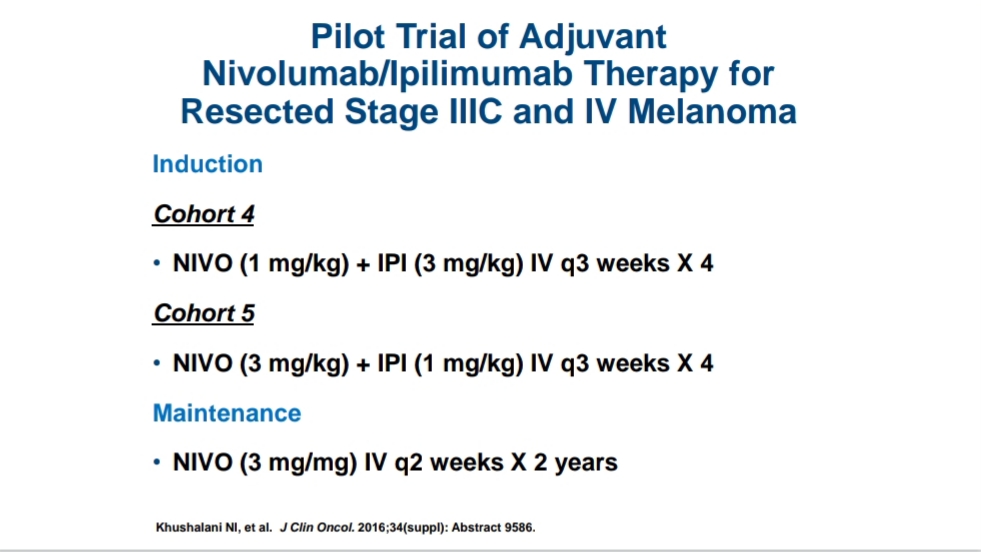
 NEXT - pilot nivo with ipi data justified a new adjuvant trial of nivo + ipi vs nivo with new biomarkers -


Forgive the blurry slides I've reproduced here.  Check the link at the top to view them for yourselves.  Hope this helps.  We've come a long way, though we have further to go.  Coming soon - the furture of immunotherapy for cancer....
Ratties rock! - c