Friday, October 2, 2020

New follow-up data confirms effectiveness for targeted and immunotherapy as adjuvant in melanoma patients!!!


Since my role as an original rattie in an adjuvant arm of Stage IV melanoma peeps using MDX1106 - today's nivolumab (Opdivo) - in 2010, I haven't stopped yelling about the need for adjuvant treatment for other melanoma patients for one minute!!!  Here are 9 zillion pertinent posts from this blog:  Adjuvant therapy for melanoma  I am particularly proud of yelling this in 2017 - 

FRIDAY, OCTOBER 13, 2017

Adjuvant treatments in melanoma - They WORK!!! Now, let's make sure people can get them!!!!!


It was certainly good news when the FDA (FINALLY!!!) approved ipi as an adjuvant treatment for melanoma.  And....it works!  ASCO 2017: Ipi 3 mg vs 10 mg in advanced melanoma and as adjuvant

We also KNOW that anti-PD-1 works EVEN BETTER, with fewer side effects, as an adjuvant treatment in melanoma. The trial that I and my fellow ratties started in 2010 proved that...and so have other studies since:  Nivo better than ipi as adjuvant treatment for melanoma! Surprise, surprise, surprise!!!

We also KNOW that BRAF/MEK inhibitors are extremely effective as an adjuvant therapy in patients with BRAF positive melanoma:  2016: Straight Outta Boston!!! Latest melanoma research ~

It is with a mixture of satisfaction, frustration, smug back patting, and hope - that I share these recent results that CONFIRM - ADJUVANT THERAPIES WORK FOR MELANOMA!!!!! 

Five-Year Analysis of Adjuvant Dabrafenib plus Trametinib in Stage III Melanoma.  Drummer, Hauschild, Saninami, et al.  New England Journal of Medicine.  September 17, 2020.

In the previously reported primary analysis of this phase 3 trial, 12 months of adjuvant dabrafenib plus trametinib resulted in significantly longer relapse-free survival than placebo in patients with resected stage III melanoma with BRAF V600E or V600K mutations. To confirm the stability of the relapse-free survival benefit, longer-term data were needed.

We randomly assigned 870 patients who had resected stage III melanoma with BRAF V600E or V600K mutations to receive 12 months of oral dabrafenib (at a dose of 150 mg twice daily) plus trametinib (2 mg once daily) or two matched placebos. The primary end point was relapse-free survival. Here, we report 5-year results for relapse-free survival and survival without distant metastasis as the site of the first relapse. Overall survival was not analyzed, since the required number of events to trigger the final overall survival analysis had not been reached.

The minimum duration of follow-up was 59 months (median patient follow-up, 60 months for dabrafenib plus trametinib and 58 months for placebo). At 5 years, the percentage of patients who were alive without relapse was 52% with dabrafenib plus trametinib and 36% with placebo. The percentage of patients who were alive without distant metastasis was 65% with dabrafenib plus trametinib and 54% with placebo. No clinically meaningful between-group difference in the incidence or severity of serious adverse events was reported during the follow-up period.

In the 5-year follow-up of a phase 3 trial involving patients who had resected stage III melanoma with BRAF V600E or V600K mutations, 12 months of adjuvant therapy with dabrafenib plus trametinib resulted in a longer duration of survival without relapse or distant metastasis than placebo with no apparent long-term toxic effects.

Good.  Now.  Enough with the placebo crapolla!!!

Longer Follow-Up Confirms Recurrence-Free Survival Benefit of Adjuvant Pembrolizumab in High-Risk Stage III Melanoma: Updated Results From the EORTC 1325-MG/KEYNOTE-054 Trial.  Eggermont, Blank, Mandala, et al.  J Clin Oncol.  September 18, 2020.

We conducted the phase III double-blind European Organization for Research and Treatment of Cancer (EORTC) 1325/KEYNOTE-054 trial to evaluate pembrolizumab versus placebo in patients with resected high-risk stage III melanoma. On the basis of 351 recurrence-free survival (RFS) events at a 1.25-year median follow-up, pembrolizumab prolonged RFS compared with placebo. This led to the approval of pembrolizumab adjuvant treatment by the European Medicines Agency and US Food and Drug Administration. Here, we report an updated RFS analysis at the 3.05-year median follow-up.

A total of 1,019 patients with complete lymph node dissection of American Joint Committee on Cancer Staging Manual, stage IIIA (at least one lymph node metastasis greater than 1 mm), IIIB, or IIIC (without in-transit metastasis) cutaneous melanoma were randomly assigned to receive pembrolizumab at a flat dose of 200 mg (n = 514) or placebo (n = 505) every 3 weeks for 1 year or until disease recurrence or unacceptable toxicity. The two coprimary end points were RFS in the overall population and in those with programmed death-ligand 1 (PD-L1)-positive tumors.

Pembrolizumab (190 RFS events) compared with placebo (283 RFS events) resulted in prolonged RFS in the overall population (3-year RFS rate, 63.7% v 44.1% for pembrolizumab v placebo, respectively;) and in the PD-L1-positive tumor subgroup. The impact of pembrolizumab on RFS was similar in subgroups, in particular according to AJCC-7 and AJCC-8 staging, and BRAF mutation status.

In resected high-risk stage III melanoma, pembrolizumab adjuvant therapy provided a sustained and clinically meaningful improvement in RFS at 3-year median follow-up. This improvement was consistent across subgroups.

Again.  Good.  Enough with placebo!!!!

There is also an update on the CheckMate 238 trial.  Here are my prior posts on that study as it progressed from 2017 and 2018 - Reports on CheckMate 238  Now, this:

Adjuvant nivolumab versus ipilimumab in resected stage IIIB-C and stage IV melanoma (CheckMate 238): 4-year results from a multicentre, double-blind, randomised, controlled, phase 3 trial.  Ascierto, Del Vecchio, Mandala, et al.  Lancet Oncol.  September 18, 2020.

Previously, findings from CheckMate 238, a double-blind, phase 3 adjuvant trial in patients with resected stage IIIB-C or stage IV melanoma, showed significant improvements in recurrence-free survival and distant metastasis-free survival with nivolumab versus ipilimumab. This report provides updated 4-year efficacy, initial overall survival, and late-emergent safety results.

This multicentre, double-blind, randomised, controlled, phase 3 trial was done in 130 academic centres, community hospitals, and cancer centres across 25 countries. Patients aged 15 years or older with resected stage IIIB-C or IV melanoma and an Eastern Cooperative Oncology Group performance status of 0 or 1 were randomly assigned (1:1) to receive nivolumab or ipilimumab via an interactive voice response system and stratified according to disease stage and baseline PD-L1 status of tumour cells. Patients received intravenous nivolumab 3 mg/kg every 2 weeks or intravenous ipilimumab 10 mg/kg every 3 weeks for four doses, and then every 12 weeks until 1 year of treatment, disease recurrence, unacceptable toxicity, or withdrawal of consent. The primary endpoint was recurrence-free survival by investigator assessment, and overall survival was a key secondary endpoint. Efficacy analyses were done in the intention-to-treat population (all randomly assigned patients). All patients who received at least one dose of study treatment were included in the safety analysis. The results presented in this report reflect the 4-year update of the ongoing study with a database lock date of Jan 30, 2020. This study is registered with ClinicalTrials.gov, NCT02388906.

Between March 30 and Nov 30, 2015, 906 patients were assigned to nivolumab (n=453) or ipilimumab (n=453). Median follow-up was 51·1 months with nivolumab and 50·9 months with ipilimumab; 4-year recurrence-free survival was 51·7% in the nivolumab group and 41·2% in the ipilimumab group. With 211 (100 [22%] of 453 patients in the nivolumab group and 111 [25%] of 453 patients in the ipilimumab group) of 302 anticipated deaths, 4-year overall survival was 77·9% with nivolumab and 76·6% with ipilimumab. Late-emergent grade 3-4 treatment-related adverse events were reported in three (1%) of 452 and seven (2%) of 453 patients. The most common late-emergent treatment-related grade 3 or 4 adverse events reported were diarrhoea, diabetic ketoacidosis, and pneumonitis (one patient each) in the nivolumab group, and colitis (two patients) in the ipilimumab group. Two previously reported treatment-related deaths in the ipilimumab group were attributed to study drug toxicity (marrow aplasia in one patient and colitis in one patient); no further treatment-related deaths were reported.

At a minimum of 4 years' follow-up, nivolumab demonstrated sustained recurrence-free survival benefit versus ipilimumab in resected stage IIIB-C or IV melanoma indicating a long-term treatment benefit with nivolumab. With fewer deaths than anticipated, overall survival was similar in both groups. Nivolumab remains an efficacious adjuvant treatment for patients with resected high-risk melanoma, with a safety profile that is more tolerable than that of ipilimumab.

So, there you go.  ALL of these adjuvant therapies provided Stage III/IV melanoma patients whose obvious disease was removed via surgery or radiation better results - no matter if they were treated with ipi, nivo, pembro or the dabrafinib/trametinib combo - than when they were left untreated.  Per these reports, here's how things panned out ~

Dabrafinib/trametinib - at 5 years, stage III melanoma patients alive without relapse was 52% with treatment vs 36% with placebo.

Pembrolizumab (Keytruda) - at 3 years, Stage III melanoma patients with recurrence free survival was 63.7% when treated with pembro, vs 44.1% for placebo.

Ipilimumab (Yervoy) - at 4 years, in Stage III and Stage IV melanoma patients, 4 year recurrence free survival was 41.2%.  4 year overall survival was 76.6%.

Nivolumab (Opdivo) - at 4 years, in Stage III and Stage IV melanoma patients, 4 year recurrence free survival was 51.7%.  4 year overall survival was 77.9%.

My thoughts:

The fact that Stage IV patients were included in the study looking at adjuvant ipi and nivo (CheckMate 238 trial) is HUGE!!!!!!  It makes comparison to the studies using pembro and the dabrafinib/trametinib combo as adjuvant in Stage III peeps ONLY, difficult to say the least.   I would really like to see an adjuvant study in Stage III melanoma patients where Keytruda and Opdivo are compared head to head, using the exact same result parameters and time frames.  I doubt there would be any significant difference in results as that has already been found to be the case when those agents are used in treatment of Stage IV melanoma patients - but still.  And finally, while the numbers for adjuvant ipi weren't that bad, and certainly much better than placebo, the side effects were greater - so I don't find ipi as a single agent a good choice for adjuvant therapy given the other options.

For what it's worth and with great appreciation to all the ratties ~ les

P.S.  FYI - time frames of follow-up matter.  As time goes on, more peeps have a chance to progress.  So data at three years may be better than outcomes reported at five years.

For instance in this article:  2017 - Nivo better than ipi as adjuvant  The data (drawn from Stage III AND Stage IV melanoma patients who took the drugs as adjuvant) demonstrates this:

Recurrence free survival at 12 months:
70.5% for nivo                    60.8% for ipi

Recurrence free survival at 18 months:
66.4% for nivo                    52.7% for ipi

That is why it is important to compare apples to apples in all aspects.  c

Tuesday, September 22, 2020

Sew Chaotically! ~ Plaid top M7890

This little project was a fun challenge.  In going through my stash for bits and bobs suitable for mask making I ran across this fabric that has probably been sitting on a shelf for about twenty years!  Too thin for masks.  Not sure why I made the purchase.  But...  It was a nice quality woven plaid in jewel tones. What to do?

I decided I could make it work as a wearable toile of McCall's 7890; a shirt dress with a diagonal button placket that I picked up on a whim in a $1.99 pattern sale but then felt unsure about.  Decision made and it was off to the races.


I stitched up a size 12.  Given my limited yardage and desire for pattern matching, cutting it was a bit of a challenge!  I obviously shortened it.  I was forced to take some of the volume out of the sleeves and had to piece the button band.  Technically the plaid at the top of the sleeve is "up-side-down" compared to how it is utilized in the bodice - still - I think it works!!  The pattern calls for the sleeves to be finished with a small cuff or elastic, but I decided I liked them simply hemmed.


Still not sure if the asymmetric button placket would drive me crazy in a dress, but it hangs nicely and is not distracting in this top. 


Happy to have had a fun diversion in this crazy time.  Glad to have transformed a piece of fabric from my shelves into a useful, pretty garment.  Stay safe!  VOTE!!!  - les

Friday, September 11, 2020

After progression on anti-PD1 / anti-PDL1 treatment of melanoma


While many patients attain a response to immunotherapy (about 40% to either anti-PD1 product and about 60% to the ipi/nivo combo) and many of THOSE responses are durable, it is clear that way too many patients are left with an inadequate response or progression after those therapies.  So, then what?  Here is a recent post containing reports on how to address that scenario:  How to deal with recurrence on or after anti-PD-1 as adjuvant or treatment for active melanoma disease

Now, there's this ~

Outcomes after progression of disease with anti-PD-1/PD-L1 therapy for patients with advanced melanoma.  Patrinely, Baker, Davis, et al.  Cancer. 2020 August. 1.
Greater than one-half of patients with melanoma who are treated with antibodies blocking programmed cell death protein 1 receptor (anti-PD-1) experience disease progression. The objective of the current study was to identify prognostic factors and outcomes in patients with metastatic melanoma that progressed while they were receiving anti-PD-1 therapy.  The authors evaluated 383 consecutively treated patients who received anti-PD-1 for advanced melanoma between 2009 and 2019. Patient and disease characteristics at baseline and at the time of progression, subsequent therapies, objective response rate (ORR), overall survival, and progression-free survival were assessed.  

Of 383 patients, 247 experienced disease progression. The median survival after progression was 6.8 months. There was no difference in survival noted after disease progression based on primary tumor subtype, receipt of prior therapy, or therapy type. However, significantly improved survival after disease progression correlated with clinical features at the time of progression, including normal lactate dehydrogenase, more favorable metastatic stage (American Joint Committee on Cancer eighth edition stage IV M1a vs M1b, M1c, or M1d), mutation status (NRAS or treatment-naive BRAF V600 vs BRAF/NRAS wild-type or treatment-experienced BRAF-mutant), decreasing tumor bulk, and progression at solely existing lesions. After progression, approximately 54.3% of patients received additional systemic therapy. A total of 41 patients received BRAF/MEK inhibition (ORR of 58.6%, including 70.4% for BRAF/MEK-naive patients), 30 patients received ipilimumab (ORR of 0%), and 11 patients received ipilimumab plus nivolumab (ORR of 27.3%).   
The current study identified prognostic factors in advanced melanoma for patients who experienced disease progression while receiving anti-PD-1, including lactate dehydrogenase, stage of disease, site of disease progression, tumor size, and mutation status.
There is also this:
Patterns of failure after immunotherapy with checkpoint inhibitors predict durable progression-free survival after local therapy for metastatic melanoma.  Klemen, Wang, Feingold, et al.  J Immunother Cancer.  Jul 2020.  
Background: Checkpoint inhibitors (CPI) have revolutionized the treatment of metastatic melanoma, but most patients treated with CPI eventually develop progressive disease. Local therapy including surgery, ablation or stereotactic body radiotherapy (SBRT) may be useful to manage limited progression, but criteria for patient selection have not been established. Previous work has suggested progression-free survival (PFS) after local therapy is associated with patterns of immunotherapy failure, but this has not been studied in patients treated with CPI.  
Methods: We analyzed clinical data from patients with metastatic melanoma who were treated with antibodies against CTLA-4, PD-1 or PD-L1, either as single-agent or combination therapy, and identified those who had disease progression in 1 to 3 sites managed with local therapy. Patterns of CPI failure were designated by independent radiological review as growth of established metastases or appearance of new metastases. Local therapy for diagnosis, palliation or CNS metastases was excluded.  
Results: Four hundred twenty-eight patients with metastatic melanoma received treatment with CPI from 2007 to 2018. Seventy-seven have ongoing complete responses while 69 died within 6 months of starting CPI; of the remaining 282 patients, 52 (18%) were treated with local therapy meeting our inclusion criteria. Local therapy to achieve no evidence of disease (NED) was associated with three-year progression-free survival (PFS) of 31% and five-year disease-specific survival (DSS) of 60%. Stratified by patterns of failure, patients with progression in established tumors had three-year PFS of 70%, while those with new metastases had three-year PFS of 6%. Five-year DSS after local therapy was 93% versus 31%, respectively.  
Conclusions: Local therapy for oligoprogression after CPI can result in durable PFS in selected patients. We observed that patterns of failure seen during or after CPI treatment are strongly associated with PFS after local therapy, and may represent a useful criterion for patient selection. This experience suggests there may be an increased role for local therapy in patients being treated with immunotherapy.
Melanoma sucks great big green hairy stinky wizard balls!  Hang tough, peeps.  Hang tough! - c

Tuesday, September 8, 2020

Sew Chaotically! ~ T shirt dress, Nani Iro Sewing Studio Pattern


I stitched up my T shirt dress, from the Nani Iro Sewing Studio Book, using a Merchant and Mills light weight cotton block print.  I used the S/M size, dropping the front neckline just a tad as I did in the blouse I made from the same pattern as a toile.  I added many inches in length as I wanted to enjoy all the beauty of this fabric!!  I had fun deciding pattern placement and am pretty stoked with my choice and stripe matching at the shoulder.


I think it worked!! Sew Chaotically! ~ les

Tuesday, August 25, 2020

Sew and Live Chaotically! ~ Alter it August - Porch refurbish!


I should have taken a "before" pic!  This portion of the front porch originally had spindles that we learned several years ago were NOT intended for outdoor use.  Leo and his side kick smeared them with a bit of wood putty and paint when we last had the porch repainted.  Unsurprisingly, this was not a real fix!  So, when some months ago B found water seal stain for half price which we need for the back porch we decided to embark on a porch re-furb!!!

We started on the front.  B removed the icky rotting spindles.
Replacing them with this!  For some reason he said, 'Never engage in carpentry with a sewist!"  No idea what brought that on! I was helping!!!

New boards in place.  Putty in needed areas.  Sanded and ready for paint!
Ta dah!

Now for the back!  B sanded all the white railings and pillars and I painted them!  Shew!

After he sanded the floor, I started painting - 1/2 at a time.  The stain was a bit redder than anticipated - but we like it!!  At half price, why not?????
The long view!  I think it works!
Still love my dragonflies from Ruthie.  I added a pillow, stuffed with sewing scraps, to the bench.
View from the opposite end with matching table cloth I stitched up!
We are lucky to be able to spend our time doing projects like this while living through this crazy time.  Stay safe.  Be confident that you can do whatever you set your mind to! - love, les

Sunday, August 23, 2020

Sew Chaotically! ~ Alter it August: From dress to skirt to top to the world! ALTER IT = VOTE!!!!!


One of my earliest makes was:
a) a pretty good rendition of my goal.
b) a HUGE learning experience.
c) worn a good deal.
d) flimpy.

Yep.  All of that.  You can read the entire story of the 'flimpy' dress here:  2016: Cute little summer dress ~ McCall's 7242  Not only was the material flimpy, it had flaws in the printing and the least little thing would put a bit of a 'run' in it.  I jacked up the collar.  Though having made the pattern twice now and gained a great deal more experience, I can tell you - there are some things about how it's drafted that just ain't right!  Still, the material is lovely on the skin.  I like the color and print.  So, I wore it!!  But, now - it is worn.  What to do?  Alter it!  Twice!!!

She was most often worn with a belt and jacket to cover the collar and the fact that the elasticized waist was odd.
Given her issues and worn and weary status, this summer I decided to hack her into a skirt.  I started to fold and stitch the waist band, when suddenly - and I don't know why, given my knowledge of this flimpy fabric - making a paper bag waist seemed like a good idea.  It wasn't.  Fabric this flimpy is NOT going to remain standing through summer heat and my activity!!!  Still, she got a couple wears in that iteration!
FREE PUBLIC SERVICE ANNOUNCEMENT:  Don't boo!!!  VOTE!!!!!!!!!!!!!!!!!!!!!!!!!!
Sew!  Given my lack of success you'd think I'd give up!  NOPE!  I turned her upside down.  Kept the button placket in center front.  Cut her into a hacked Paris Top by Orageuse leaving off the sleeves and cutting the cute shoulder details and neck facings from the skirt pockets.


There!!!  I think I'll keep her this way.  She should be good for a few more wears!!!

Like my dress, our world is jacked in too many ways to count at the moment.  Still, there is beauty and value under all the mess. If we don't like what we see, we have the power to ALTER IT!!!!  Make things better.  Create a world that reflects what you value and need for you and your loved ones.  Just like we sewists can change our makes, we can ALL change our leadership.  Don't like how things are going?  ALTER THEM!!!  VOTE!!!

Stay safe.  Be the change you seek! VOTE! - love, les

Friday, August 21, 2020

Sew and Live Chaotically! ~ Quarantine-while means Mask Making - Japanese Sewing Book Masks!


Mask Making!!  Not exactly happy sewing, but happy I can do something to help.  In a rush, I made my four kiddos some masks back in May.  They were quick and dirty, but they did what they needed to do!  All were made with two layers of tightly woven cotton left over from prior makes with a layer of melt blown filter fabric inserted between.  Much praise to the many pattern companies who have been incredibly generous in providing an abundance of free, downloadable mask patterns.  Here's my take...

For the tri-fold version above I made a bit of a mish-mash of the Tilly and the Buttons version (which has a great how-to video) and McCall's Face Cover.  I added a nose wire between the pieces.  They work pretty well for a variety of face shapes, but do tend to get "eaten" if you have to talk a lot while wearing.  
Freddo and I preferred the State the Label version.  My other creatures felt that it was too small.  I could certainly tweak the size, but there you go.
Knowing I needed to make more, I reviewed tons of mask patterns offered via the internet and considered adapting the patterns above.  Simultaneously, the sewing community was mask making like crazy and kindly sharing their tips.  Through them I found what I consider to be the BEST mask pattern:  Japanese Sewing Books - Free Mask Pattern Download – Contoured 3D Face Mask  Several sizes are included.  I made the "large" for my ladies and the "XL" for my men folks.  There are additional sizes.  An XXL, M, S, and XS with measurements included.
Armed with that finding, I made 40 for more peeps and teachers at my daughter's school.  Again, all are two layers of tightly woven cotton with the blown filter fabric sandwiched between.  You can use ties or elastic around the head or ears.  With elastic at a premium, for the most part, I used ties made from bias binding, but also made use of a strange colorful collection of shoe laces we had on hand!  Ties do make it easy to fit heads you don't have access to!
The link shared above includes a great video tutorial.  But, just to give you an idea of how I layer the pieces with the filter ~ stitch edges of your mask pieces, inner most bits on the outside.
I had hoped the way this mask is stitched and folded - almost origami style - would obviate the need for a wire nose piece, and while it does better than any others, the use of 4 - 4 1/2 inches of plastic covered wire really does make the fit much better.  I insert it between the layers, after I've stitched the edges as seen above, turned/pressed the layers, and top stitched around the top and bottom.  After pinning the wire in place, I stitch at either end, then run a line of stitching just below it.  A zipper foot or regular foot with the needle positioned toward the edge helps the process.   Other sewists are placing a nose wire in a tunnel from which it is removable for laundering.  So far, mine are holding up well to washing in the machine and air drying.
Here's how it looks inside when finished.
You can easily use elastic, or pieces of stretchy knit fabric, to create loops to be worn over the ears - elastic to go round the head - or ties as I have here.  If you do opt for ties, it is best to attach them at the side, so they won't keep slipping when the wearer tries to tie them in place.  You also need the longer portion toward the top.  Just play around with it to see what works best for you.
And there you have it!
These are quite comfortable in that they stay in place, do the job they need to do with a good occlusive seal, yet stay away from your face in a way that facilitates breathing and speaking!  Sew!  On to another batch. Making the ties is the most time consuming and least fun part! Although...
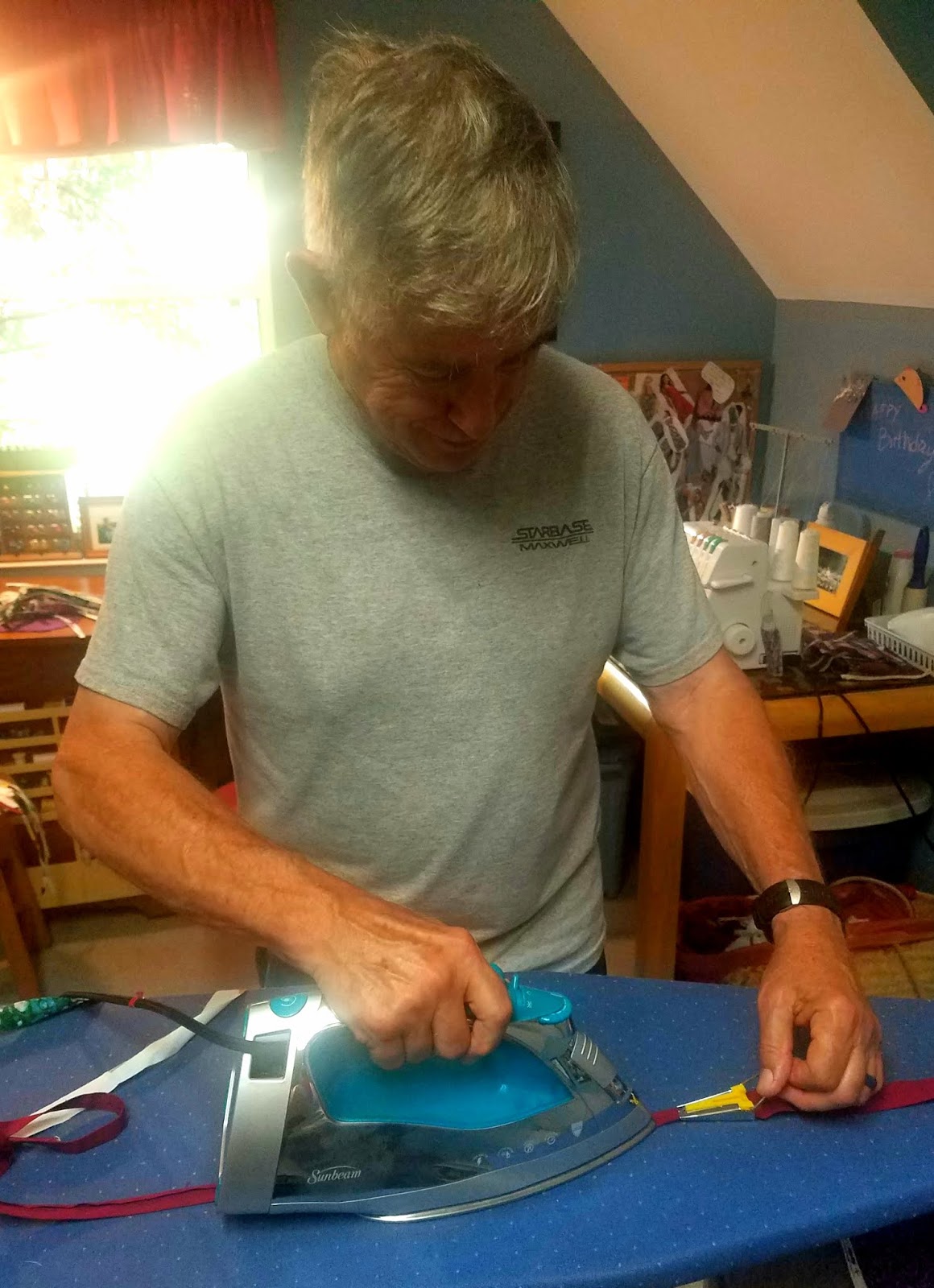
I do have a secret weapon!!!!  B has been helping me in my production line!!  He has become quite adept at turning and pressing, making bias tape and pinning nose pieces in place!!!
There!  Another batch of ties done!
Just in time for another batch of 15!
And another 4!  I thought these turned out really cute!
More FREE mask patterns:

This one was very tempting to me and has good reviews among sewists.  It is similar to the Japanese Sewing Book Pattern - Free Mask pattern by Aplat

This one is similar to the State the Label pattern above - Victory Patterns free face mask pattern

Along the same lines - Free from Craft Passion

Also tempting and along the State the Label lines, though with a bit more fabric and fit beneath the chin, in multiple sizes - Dhurata Davies free mask pattern

Simple tri-fold version, with pocket for filter - Makers Habit free mask pattern

Similar tri-fold version - Butcher's Sew Shop free mask pattern

Another simple folded version - Free from Fibre Mood

Simple folded mask with ties - free from Mood Fabrics

Includes a sewn and no-sewing version - Deaconess Face Mask

NOT free, but with a piece of fabric under the chin - cost = 2 pounds, supposedly donated to charity -Trend Patterns PDF

Take care.  Wear a mask.  Pull together and stay apart!  Much love to the sewing community for all the info and support they share. Great thanks to all the pattern makers who made their patterns available and free to the world!!!  Hang tough, guys! - les